
I Will Only Film My Reels with Ray-Ban Meta Glasses. And I Want Women to Film Me.
Flipping the Gaze: FatbikeHero’s Consent-First Experiment in Wearable AI, Art and Representation.
Experiment v1.0 | 10 October 2026 | Aarhus, Denmark
From today, I am recording my Instagram Reels exclusively with my Ray-Ban Meta glasses.
But that is only half the experiment.
The other half is what really interests me.
I want to invite consenting women I encounter to put on my AI glasses and film ME.
Yes. FatbikeHero.
I want to see what happens when I hand over the camera and allow women to decide how they want to represent me.
Because history is full of images shaped by the male gaze.
And I want to flip the script.
HISTORY IS FULL OF THE MALE GAZE
Look at ancient mythology. Look at classical paintings, sculptures, photography, cinema and advertising.
For centuries, images of women have often been created through the eyes, desires and imaginations of men. Men have painted women, photographed women, written stories about women and helped shape how women have been represented in visual culture.
Of course, women have always been artists, photographers, filmmakers and storytellers, too. This is not about erasing their contributions.
But the history of art raises a question that fascinates me:
What happens when we change the person who is looking?
Film theorist Laura Mulvey explored the male gaze in her influential 1975 essay Visual Pleasure and Narrative Cinema. She examined how cinema can position women as objects of a masculine viewpoint, shaping how audiences look at and interpret them.
That conversation has influenced decades of film theory and discussions about representation.
I am interested in exploring the question from my own little corner of the art world.
What happens when I, a man who deliberately makes himself a spectacle, invite women to decide how they see me?
Not how I want them to see me.
Not how I would film myself.
How THEY see me.
That is the starting point of this experiment.
I AM USUALLY THE ONE CREATING THE SPECTACLE
If you know me, you know what I do.
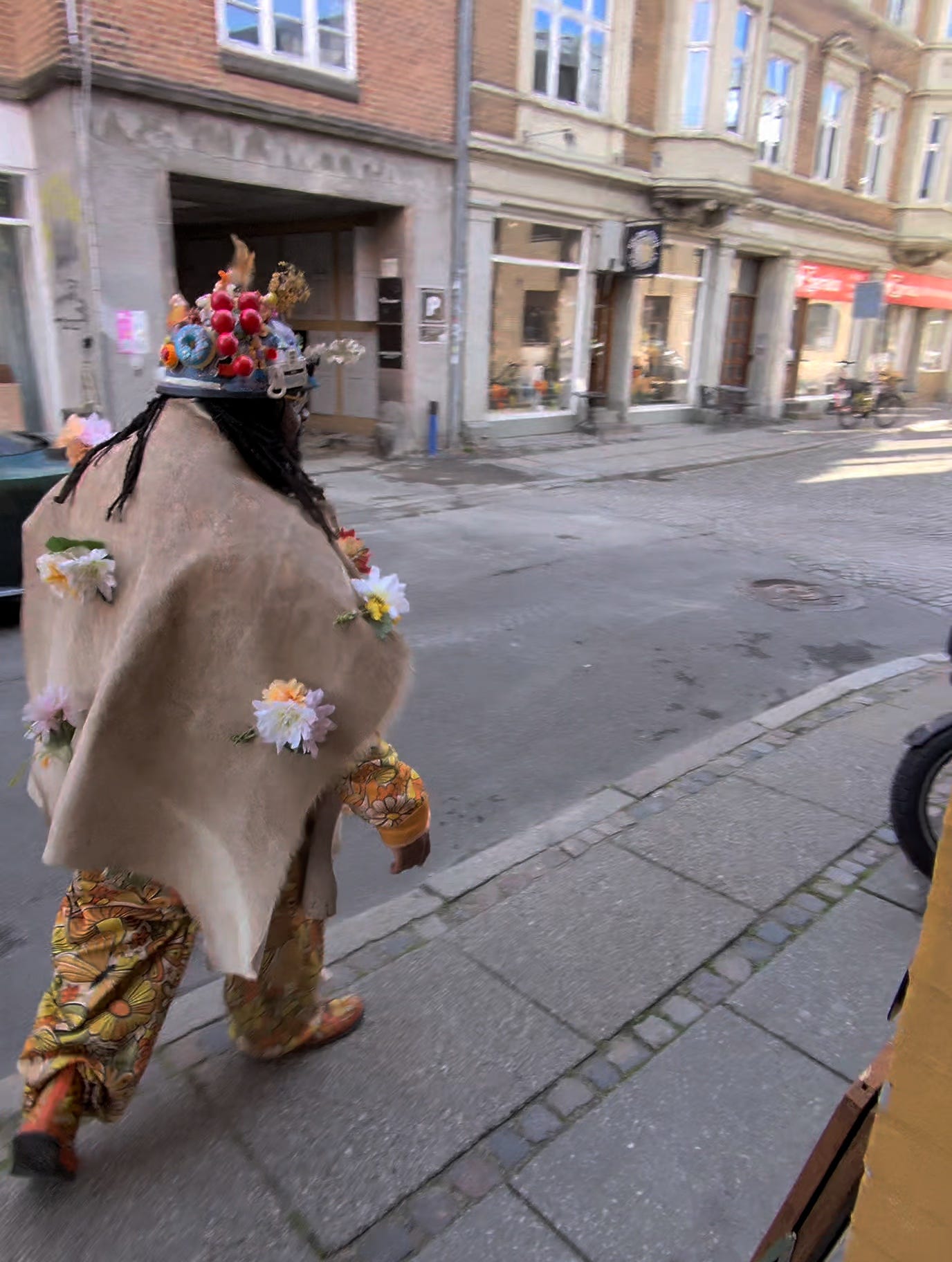
I ride around Aarhus on my electric fatbike, dressed in colourful, sometimes completely ridiculous costumes, playing music and creating unexpected encounters with people.
I do it because I love bringing smiles to people.
I believe in play. I believe in spontaneous human encounters. And I believe that growing older does not mean you have to stop being playful.
I am usually the one initiating the encounter. I choose the costume, ride into the world and become the person people look at.
When I record my performances, I also decide how the audience sees me.
I choose the angle. I choose the moment. I choose what makes it into the Reel.
But what if I let somebody else make those choices?
What if I invited a woman I meet on the streets of Aarhus to put on my Ray-Ban Meta glasses and film me from her own perspective?
What would she notice?
Would she focus on my costume, my face, the way I ride or the absurdity of a grown man refusing to stop playing?
Would she find something funny that I don’t even realise I am doing?
Would she capture something beautiful, strange or unexpected that I would never have thought to record?
I don’t know.
And that is precisely why I want to try it.
THE FEMALE GAZE: LET WOMEN DECIDE WHAT THEY SEE
Let me be clear about something.
I am not claiming that all women see the world in the same way. There is no single female perspective that every woman shares. And putting a pair of AI glasses on a woman does not automatically produce a female gaze.
That would defeat the whole purpose.
I want to give individual women the freedom to express their own perspectives.
One woman might film me as a comedian. Another might see a performance artist. Another might capture a man who has simply decided that life is too short to take himself seriously.
Perhaps someone will notice something that challenges the image I have created of myself.
That is what interests me.
I am not directing these women to produce a particular interpretation. I am inviting them to make their own creative choices about what they see and how they frame it.
I want to become the subject of somebody else’s gaze without dictating what that gaze should be.
This is not about women filming women, or men filming men. It is about a man voluntarily handing over control of his image to women who choose to participate.
The experiment asks a simple question: what can I learn about my own artistic identity when I allow someone else to interpret it?
I spend a lot of time trying to make other people smile.
Now I want to see what they see when they look at me.
WHY THE AI GLASSES MATTER
Why Ray-Ban Meta glasses? Why not simply hand someone my phone?
Because the glasses offer a particular first-person perspective.
The camera follows the wearer’s viewpoint without requiring them to hold a phone. When another person wears my glasses, the footage comes from their perspective as they observe and film me.
The technology makes it possible to explore a small but meaningful shift in the creative relationship.
I remain the performer. But somebody else temporarily controls the camera.
The person who normally watches becomes the filmmaker. The person who normally performs becomes the subject.
For me, this is where wearable technology becomes interesting as an artistic tool.
I am not interested in using AI glasses to secretly record strangers or turn unsuspecting people into online entertainment. I want to explore how the same technology can support deliberate, collaborative and consent-based creative work.
The glasses are not the artwork by themselves.
The artwork emerges from the encounter, the change in perspective and the choices made by the people participating.
AND YES, CONSENT MATTERS
There is a reason I am making this commitment publicly.
Smart glasses have raised legitimate concerns about people being recorded without their knowledge, particularly when cameras are built into devices that resemble ordinary eyewear.
I understand why people are uncomfortable with that possibility.
Just because technology makes recording easier does not mean recording someone is always appropriate. And being in a public place does not automatically mean agreeing to appear in somebody else’s Instagram Reel.
My experiment is built around a different approach.
I will explain what I am doing and ask women if they want to participate. I will obtain their permission before recording them as participants and seek permission before publishing the resulting footage.
If someone declines, that is the end of it. No pressure, no argument and no attempt to persuade them.
I will not cover or circumvent the glasses’ recording indicator. I will not use this project as an excuse to secretly record private conversations or people in sensitive settings.
I will also take care to exclude, crop or blur identifiable bystanders where appropriate, and I will not publish identifiable children without explicit parental consent.
A recording light is not consent. Consent to being recorded is not automatically consent to publication. And inviting someone to participate does not remove my responsibility for how the footage is used.
These are voluntary commitments guiding my artistic practice, not a claim that the experiment automatically satisfies every applicable legal requirement.
For me, respect for the people participating is part of the work itself.
THIS IS ARTISTIC RESEARCH, NOT A CLAIM TO HAVE ALL THE ANSWERS
I want this to become a sustained experiment rather than a one-day stunt.
My Instagram Reels will be recorded exclusively using my Ray-Ban Meta glasses. Alongside my own first-person recordings, I will invite willing participants to wear the glasses and film me from their own perspectives.
I want to explore questions of authorship, representation, consent and the relationship between the person behind the camera and the person in front of it.
What changes when I surrender control of the frame?
How do different participants interpret the same performer?
Can wearable technology make it easier to share authorship without compromising consent?
What happens when an artist deliberately invites others to challenge the image he has constructed of himself?
This is not a controlled scientific study, and my experience will not establish what all women think or settle the broader debate about AI glasses.
It is an artistic investigation that I intend to document honestly.
I also plan to publish monthly transparency updates through Instagram Stories, describing how the experiment develops, what I learn and what I would change. The aim is to make the process open to scrutiny rather than simply announcing good intentions.
I want people to question the experiment. I want to hear different perspectives. And I want to remain open to the possibility that the things I discover may challenge my original assumptions.
That is part of doing the work.
FROM CONTROVERSY TO CREATIVE POSSIBILITY
I do not believe every new technology should automatically be celebrated. Nor do I believe every new technology should automatically be banned.
Smart glasses can create genuine privacy risks. They can also offer possibilities for accessibility, communication, personal documentation and creative expression.
The important questions include how the technology is used, who is affected, what consent is obtained and what safeguards exist.
My experiment focuses on one specific possibility: using wearable cameras to create consent-based, collaborative art.
But I also want to push the artistic question further.
For generations, visual culture has invited us to examine who controls the image of another person. My experiment reverses that relationship in a small, practical way.
I am the person being looked at. I am inviting women to choose how they represent me. And I am interested in the differences between their interpretations.
This does not mean that every resulting video will represent a universal female gaze. It means that each participant gets the opportunity to contribute an individual perspective.
The technology provides the means. The encounter provides the context. The person wearing the glasses makes the creative choices.
That is the distinction I want to explore.
I WANT TO SEE FATBIKEHERO THROUGH YOUR EYES
My whole FatbikeHero philosophy is about bringing smiles to people.
I ride around in ridiculous costumes because I believe life is already serious enough. I want to create moments of joy, encourage people to play and remind them that there is nothing wrong with being a grown-up who still has the spirit of a child.
Now I want to add another dimension to that practice.
I want to hand over the camera.
I want women who choose to participate to decide what they notice, what they find interesting and how they want to frame me.
Maybe they will capture the ridiculousness. Maybe they will capture the joy. Maybe they will see something I have never considered.
I cannot know in advance.
And I don’t want to.
For once, I don’t want to control the gaze. I want to see what happens when I give it away.
Starting today, my Ray-Ban Meta glasses become part of my artistic practice: a tool for first-person documentation and an invitation to explore shared authorship.
I am FatbikeHero. I am going to keep riding, keep playing and keep bringing smiles to Aarhus.
But now I want to discover what happens when other people get to decide how they see me.
I love to PRAY AND PLAY, in that order.
And perhaps there is something else worth exploring: letting others look, letting others create and being willing to see yourself differently.
I have spent years making people smile. Now I want to see myself through your eyes.
Let’s see what you see.
Tendai Frank Tagarira (FatbikeHero)
Artist and filmmaker
Aarhus, Denmark
FatbikeHero Consent-First AI Glasses Experiment — Version 1.0, 10 October 2026.
An ongoing artistic exploration of the female gaze, first-person filmmaking, collaborative authorship, consent and wearable technology. This statement describes the artist’s intentions and voluntary commitments; it is not a legal assessment of privacy or data protection.