
Tendai Frank Tagarira (FatbikeHero) Award Winning Artist and filmmaker, Aarhus, Denmark Working paper · October 2026 · fatbikehero.com

Abstract
Camera-equipped smart glasses have made first-person filming effortless, and in doing so they have revived an old social fear: the person who records others without asking. This paper places a body of practice begun in Aarhus in October 2026, Consent-First Wearable Filmmaking, within the century-long history of point-of-view (POV) and body-worn cinema. The practice was publicly declared on 10 October 2026 and continued in the collaborative comedy series AI GLASSHOLES (with performer Denise Wiersma). It asks whether the same device that produced the “glasshole” can be turned into an instrument of shared authorship. The paper sets out the lineage, from Abel Gance’s chest-mounted camera (1927) through Steve Mann’s wearable webcam (1994), the GoPro feature Hardcore Henry (2015), Snap Spectacles and Ray-Ban Meta brand films, to the 2026 controversy over “pervert glasses”. It then describes the protocol’s three contributions: a written, public consent standard that separates permission to record from permission to publish; deliberate gaze reversal, in which the artist hands the glasses to others and becomes their subject; and a serialised satirical form that makes the glasses’ social misuse the comic subject of the work. The paper makes a deliberately narrow priority claim, and it is explicit about what it does not claim.
Keywords: wearable filmmaking, POV cinema, smart glasses, Ray-Ban Meta, consent, bystander privacy, female gaze, shared authorship, artistic research, AI GLASSHOLES
1. Introduction
Smart glasses are, before anything else, a camera that no longer needs a hand. That single change removes the gesture that has always told a room that someone is filming: the raised phone or the lifted lens. In 2026 the change became a public argument. Reporting described women filmed covertly by glasses wearers and posted online for entertainment (The Guardian, 2026; CBS News, 2026). Activist posters rebranded the product as “mass surveillance predator glasses” (The Verge, 2026). An Irish senator called for limits after a string of non-consensual recordings in Cork (Irish Examiner, 2026). The music press began to treat “pervert glasses” as common usage (Music Ally, 2026).
This paper documents a counter-practice that took the glasses at their word, hands-free first-person capture, and then rebuilt the social contract around them. On 10 October 2026, I publicly committed to recording my Instagram Reels exclusively with Ray-Ban Meta glasses, and only with consent (Tagarira, 2026a). Eight days later, the practice became a two-artist collaboration with the Argentine-born performer Denise Wiersma (Tagarira, 2026b). From 21 October 2026 it also became a serialised comedy, AI GLASSHOLES.
My argument is that this is not just “POV content”. It is a protocol: a set of public, falsifiable commitments about who may be filmed, who holds the camera, and who decides what is published. It is paired with a comic form that turns the anxiety around the device into the subject of the work.
2. A Short History of Wearing the Camera
Putting the camera on the body is not new, and no honest account of wearable filmmaking can begin in 2026.
2.1 Early cinema. In Napoléon (1927), Abel Gance had a camera padded and strapped to the chest of cinematographer Jules Kruger to film a snowball fight. It is often cited as cinema’s first visceral body-worn shot (ACMI, 2016). Robert Montgomery’s Lady in the Lake (1947) went further and told an entire murder mystery through the eyes of detective Philip Marlowe (The Hollywood Reporter, 2016).
2.2 Wearable computing and “personal imaging”. The most important ancestor of the smart-glasses camera is Steve Mann. His wearable computer systems date to the late 1970s and early 1980s (IEEE Spectrum, 2013), and his “Digital Eye Glass” work began in 1978 (Wikipedia, “Steve Mann (inventor)”). In December 1994 his Wearable Wireless Webcam sent images from a head-mounted camera to the web in near real time (MIT Media Lab, n.d.). Mann himself described the result as “a new genre of cinematography” and a “personal documentary” of daily life (Mann, n.d.). Any claim to have pioneered wearable filmmaking in general would be historically false. That title belongs to this lineage.
2.3 The action-camera era. The GoPro made body-worn capture cheap. Ilya Naishuller’s music video Bad Motherfucker (2013) led to Hardcore Henry (2015), a feature shot almost entirely in the first person on a custom helmet rig carrying GoPro HERO3 cameras (fxguide, 2016; CNET, 2016).
2.4 Camera glasses and the birth of the “glasshole”. Google Glass (2012–2015) moved the lens to the eye line, and with it came a new insult. Glasshole was apparently coined on Twitter by “Startup L. Jackson” in October 2012 (TIME, 2014) and had entered general usage by April 2013 (The Atlantic, 2013). By February 2014, Google’s own etiquette guide was telling users not to be “creepy or rude (aka, a ‘Glasshole’)” (PR Daily, 2014). Documentary maker Chris Barrett’s footage of an arrest filmed through Glass in July 2013 showed how quickly the device became an instrument of witnessing (VentureBeat, 2013).
2.5 Spectacles, Ray-Ban Stories and Ray-Ban Meta. Snap released Summaeverythang (2020), a short film by Los Angeles artist Lauren Halsey shot entirely on Spectacles 3 (Next Reality, 2020). Meta and EssilorLuxottica launched Ray-Ban Stories in 2021 and Ray-Ban Meta in October 2023 (Wikipedia, “Meta smart glasses”). The brand quickly commissioned glasses-shot work. Matthew Vaughn directed a three-minute action film shot entirely on Ray-Ban Meta glasses for Meta Connect 2024 (Campaign US, 2024). OK Go published a behind-the-scenes film shot by eleven crew members wearing the glasses (OK Go, 2025). In October 2026, Doja Cat premiered Ma Vie World Tour, a 12-minute documentary short that Meta describes as filmed “almost entirely” on Ray-Ban Meta glasses (Music Ally, 2026; Mixed News, 2026). Independent creators built followings on glasses-shot vlogs and street comedy. One example is the “Computah” character, a parody performer who “programs” strangers on Chicago trains (The Byte Report, 2026).
2.6 What the lineage shows. By 2026, first-person glasses footage was common, often commercially sponsored, and on the street often non-consensual. The open question was no longer whether the glasses could make films. It was on whose terms.
3. The Consent Problem as a Formal Problem
Meta’s own answer to bystander privacy is a capture LED: a light that shows when recording is happening. It was enlarged on Ray-Ban Meta from 0.9 mm to 2 mm, with a blinking pattern and tamper detection (Meta, 2025). Legal scholarship has argued that such signals amount at best to presumed consent, and has proposed mandatory “privacy frictions” as bystander notice (Takhshid, 2024). Advocacy groups have put the point more bluntly: a light that can be missed, disabled or blocked “isn’t consent” (XRSI, n.d.).
For a filmmaker, this is not only an ethical question but a formal one. The defining aesthetic quality of glasses footage, its intimacy and lack of an apparent operator, is the same quality that makes subjects unaware they are being filmed. A practice that wants the intimacy without the predation has to rebuild consent into the method. A disclaimer cannot do that work.
4. The Protocol: Consent-First Wearable Filmmaking (v1.0)
The protocol was published on 10 October 2026 as Experiment v1.0 (Tagarira, 2026a). It was extended into a collaborative “chapter two” on 18 October 2026 (Tagarira, 2026b). Its operative commitments are:
Single instrument. All Instagram Reels are recorded only with Ray-Ban Meta glasses. The constraint is aesthetic as well as ethical: one viewpoint, one device, no hidden second camera.
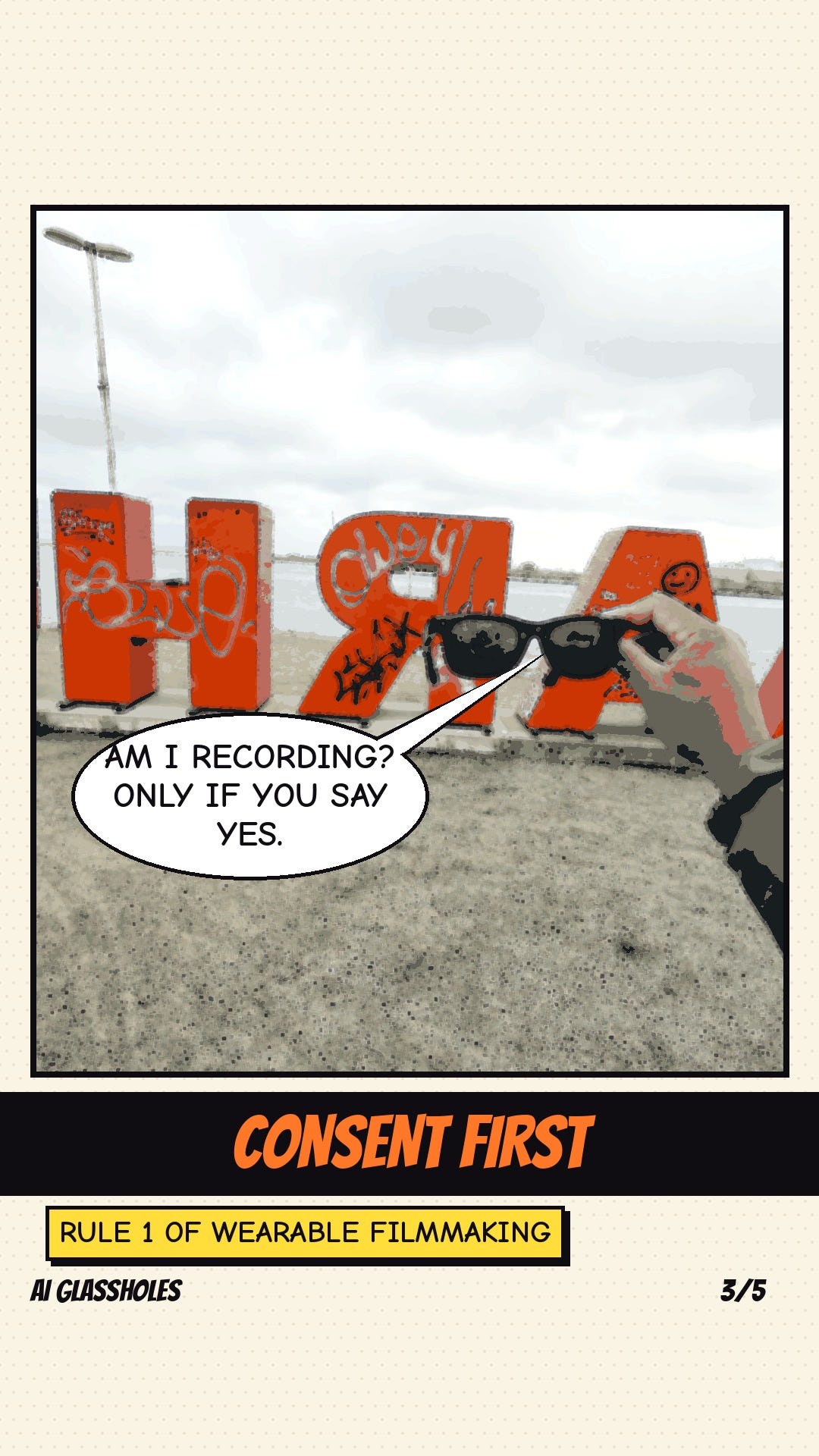
Ask first. Participants are told what is happening and asked before they are recorded. A refusal ends the matter: “no pressure, no argument.”
Two separate consents. “Consent to recording is not consent to publication.” Participants are asked again before anything is posted.
The light stays visible. The recording indicator is never covered or circumvented.
Bystander and child protection. Identifiable bystanders are cropped or blurred where appropriate, and children are never published without explicit parental consent.
Shared authorship. In the collaboration, both artists decide what is published.
Public accountability. Monthly transparency updates on Instagram Stories open the process to scrutiny.
The 4 S’s. Spontaneous (plan the invitation, not the outcome), Self-Funded (no sponsor decides what the art says), Sovereign (everyone keeps control of their image and voice), and Smiles (if it doesn’t make someone smile, it isn’t finished).
The protocol also states its limits: it describes “voluntary commitments … not a claim that the experiment automatically satisfies every applicable legal requirement” (Tagarira, 2026a). That self-limitation matters. It frames the work as artistic research and not as compliance theatre.
5. Gaze Reversal: Giving Away the Glasses
The protocol’s most distinctive move is not the consent rules but who wears the device. Laura Mulvey’s 1975 essay Visual Pleasure and Narrative Cinema described how classical cinema positions women as objects of a masculine look. Smart glasses literalise that look: the wearer’s gaze is the camera.
Experiment v1.0 inverts the arrangement. I invite women who choose to take part to put on my glasses and film me (Tagarira, 2026a). I usually choose the costume, the angle and the edit. Here I give up the frame. The protocol is careful not to claim a single “female gaze”: “There is no single female perspective that every woman shares”, and each participant brings an individual one. In chapter two, Denise Wiersma and I film each other and set both gazes side by side, with most of the work centred on hers (Tagarira, 2026b).
The device critics fear as an instrument of the male gaze becomes, in this practice, a means of handing the gaze away. Within the case studies identified in Section 2, every celebrity and brand film keeps the camera with its star or crew, and the street-comedy formats keep it with the performer. I found no other documented case in that sample of an artist making the transfer of the glasses to the subject the method of the work.
6. AI GLASSHOLES: Satire as Method
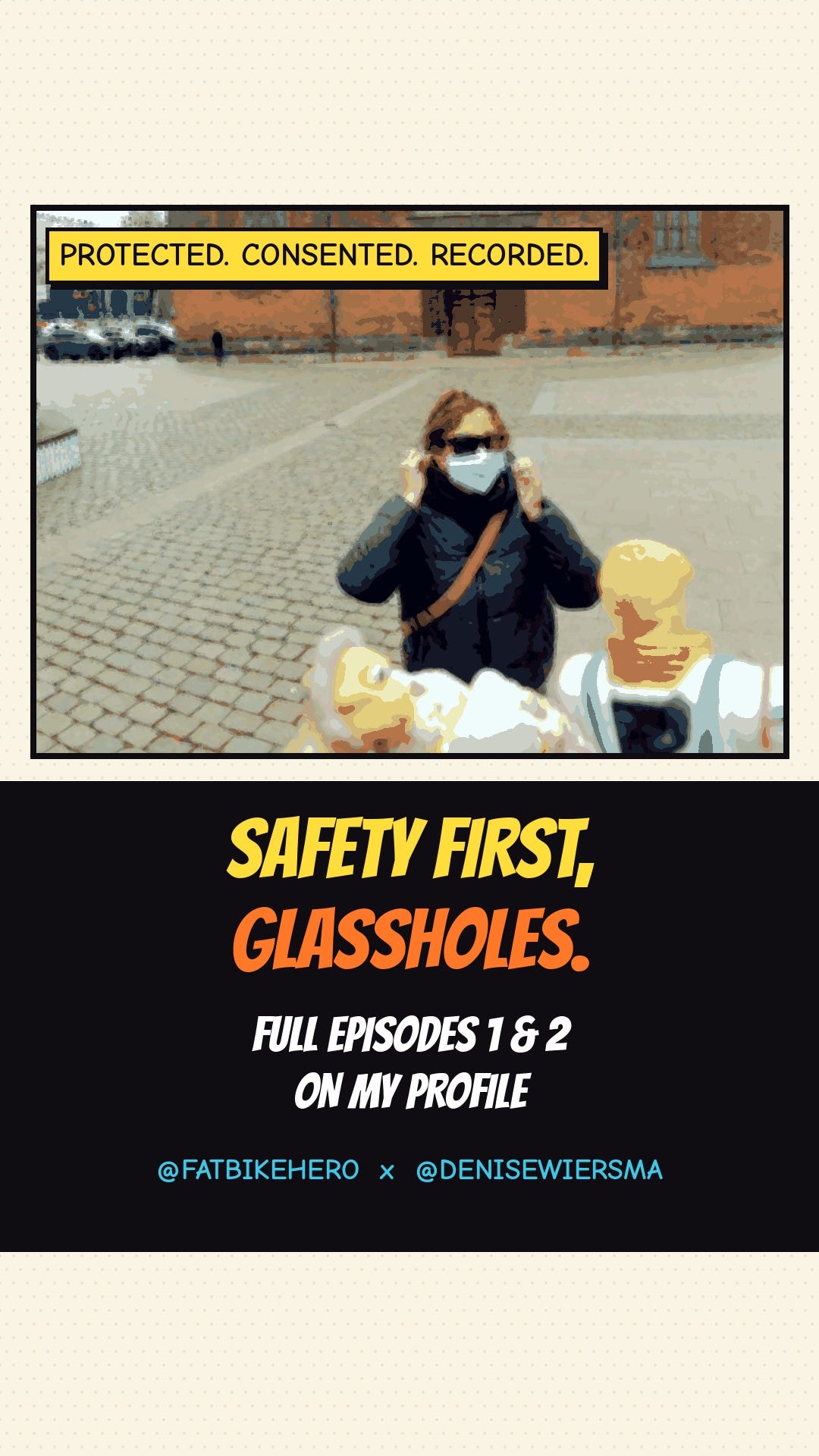
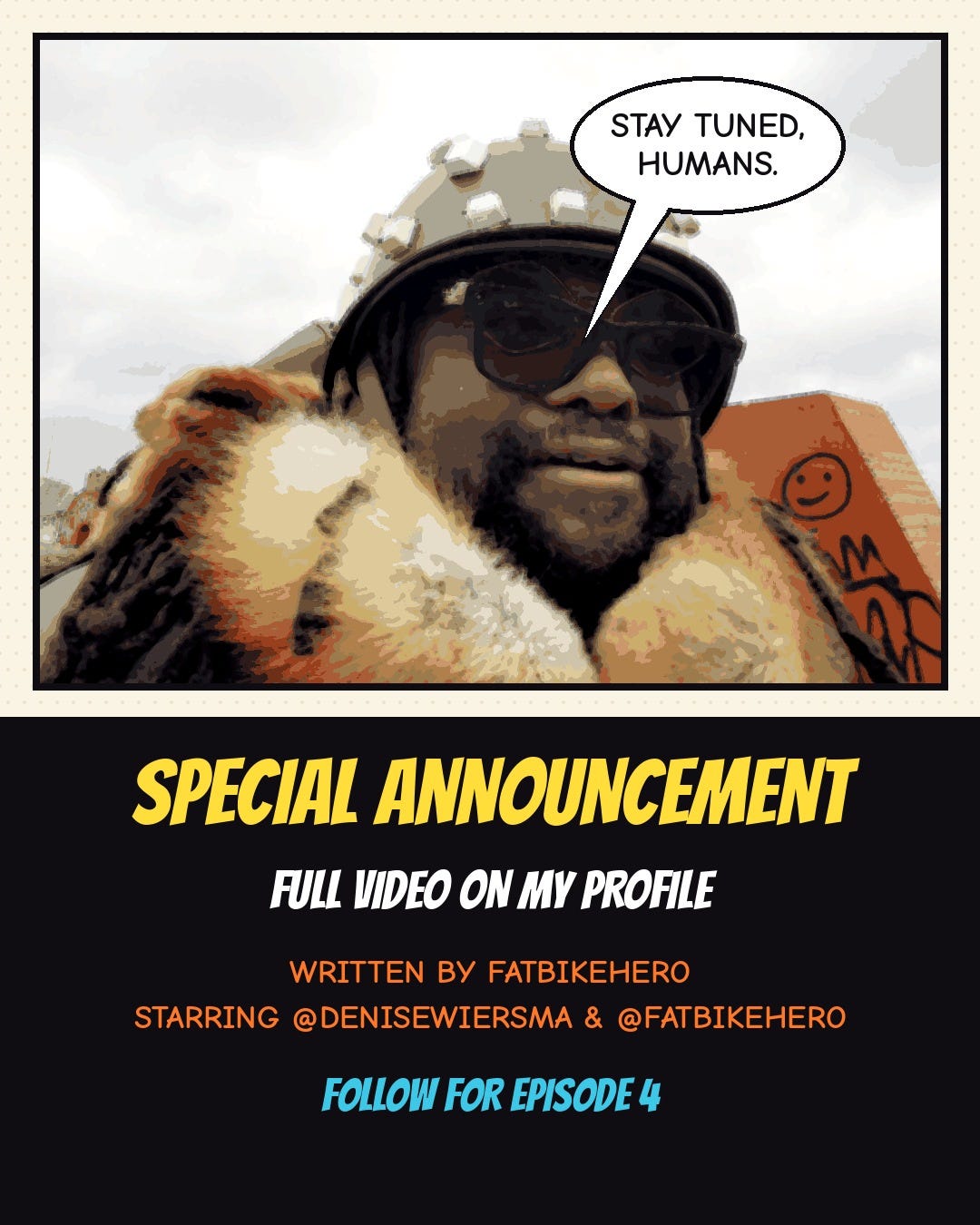
AI GLASSHOLES is the serialised comedy strand of the practice, made with Denise Wiersma. It began with two episodes filmed on 21 October 2026. Its title reclaims the 2012–2013 insult, and its comedy takes the social misuse of the device as its subject. The series uses three recurring forms:
Split-screen gaze comparison. The Ray-Ban view (with its audio) runs above a second perspective. A hook such as “Who eats it better?” invites the audience to compare looks, not just watch one.
Deadpan scepticism inside the frame. Wiersma plays an AI sceptic, so the critique of the device is spoken within footage made by the device.
Parody advertising. A fake commercial for “LED Blokkers”, stickers that hide the recording light, ridicules the exact behaviour the protocol forbids. Meta’s own safeguards block recording when the LED is covered, which makes the product absurd twice over (Meta, 2025).
Satire does work that a statement of principles cannot. It shows the glasshole as a recognisable comic type, and it asks the audience to laugh at the covert recorder rather than with him. This follows the FatbikeHero principle that a work isn’t finished until it makes someone smile.
7. Positioning and Priority
Because this paper will be published under my own name, its claims must hold up against the record. They are stated narrowly.
What this paper does not claim. - It does not claim that I pioneered wearable filmmaking, POV cinema or smart-glasses filmmaking. Gance, Montgomery, Mann, Naishuller, Halsey, Vaughn and many others came first (Section 2). - It does not claim to be the first film or series shot on Ray-Ban Meta glasses. Brand-commissioned glasses films date to at least 2024. - It does not claim to have coined “wearable filmmaking” or “glasshole”. Both terms were already in circulation. - It does not claim to be the first or only creator to ask permission before filming with glasses. Many creators do, and a 2025 open-source tool already blurred faces unless people gave verbal consent (Hacker News, 2025).
What this paper does claim, with its evidence. 1. Authorship of a named, dated, public protocol. Consent-First Wearable Filmmaking: An Artistic Research Experiment, Experiment v1.0, was published by me on 10 October 2026 with explicit, checkable commitments (Tagarira, 2026a), and extended on 18 October 2026 (Tagarira, 2026b). 2. A documented method of gaze reversal with smart glasses. The 10 October 2026 statement makes handing the glasses to consenting women, who then film the artist, the central method of the work. 3. Co-creation of AI GLASSHOLES. This is a consent-first, co-authored comedy series that satirises smart-glasses misuse and was made on the glasses themselves, beginning October 2026. 4. An early independent artistic response. The protocol was published at the height of the 2026 controversy, and it is self-funded rather than brand-commissioned, as the 4 S’s require.
The fair description is therefore: an early independent practitioner and the originator of the Consent-First Wearable Filmmaking protocol. It is not “the pioneer of wearable filmmaking”. The narrower claim is stronger, because every part of it can be checked.
8. Limitations and Further Work
This is practice-based artistic research, not a controlled study. Its sample is small, local (Aarhus) and young: the protocol was weeks old at the time of writing. Several things would strengthen the record:
Permanent archiving. Deposit this paper and the v1.0 protocol on Zenodo with DOIs, and archive the Substack pages on the Internet Archive.
Dated episode permalinks. Each AI GLASSHOLES episode should be published with its public URL, its posting date and a credit to the co-author.
Published transparency reports. The monthly updates promised in v1.0 should be kept as permanent posts, not only as 24-hour Stories.
Independent review. Invite outside commentary from film scholars, privacy researchers, and participants’ own accounts of being filmed and of filming.
Legal review. Commission a review under Danish law and the GDPR, as the protocol itself suggests.
9. Conclusion
The camera has been worn on the body for a century, and the camera in the glasses for more than a decade. What changed in 2026 was public tolerance. The glasshole returned, and with him the reasonable fear of being turned into someone else’s content. Consent-First Wearable Filmmaking does not answer that fear with a better light or a longer disclaimer. It changes the relationships around the device: it asks twice, it hands over the frame, and it laughs at the covert recorder in public. Its claim to originality is small and precise, and for that reason it holds.
“A recording light is not consent. Consent to being recorded is not automatically consent to publication.” (Tagarira, 2026a)
References
ACMI (2016) ‘The History and Future of the POV Film’, Medium, 13 April. https://medium.com/acmi/the-history-and-future-of-the-pov-film-999a5704048e
Campaign US (2024) ‘How filmmaker Matthew Vaughn made an action movie with Meta Ray-Ban glasses’, 26 September. https://www.campaignlive.com/article/filmmaker-matthew-vaughn-made-action-movie-meta-ray-ban-glasses/1890127
CBS News (2026) ‘Woman covertly filmed by Meta AI smart glasses raises privacy and consent concerns’, 21 August. https://www.cbsnews.com/news/meta-ai-smart-glasses-covert-filming-privacy/
CNET (2016) ‘This action movie was shot almost entirely with a GoPro’, 16 March. https://www.cnet.com/culture/hardcore-henry-action-movie-ilya-naishuller-shot-almost-entirely-with-gopro
fxguide (2016) ‘How Hardcore Henry’s POV shots were made’, 20 April. https://www.fxguide.com/fxfeatured/how-hardcore-henrys-pov-shots-were-made/
Hacker News (2025) ‘Show HN: Real-time privacy protection for smart glasses’, 14 August. https://news.ycombinator.com/item?id=44868563
IEEE Spectrum (2013) Mann, S., ‘My “Augmediated” Life’, 1 March. https://spectrum.ieee.org/steve-mann-my-augmediated-life
Irish Examiner (2026) ‘Calls to limit the use of “creepy” AI smart glasses to film people without consent’, 20 May. https://www.irishexaminer.com/business/technology/arid-41847729.html
Mann, S. (n.d.) ‘An historical account of the WearComp and WearCam inventions developed for applications in Personal Imaging’. http://hi.eecg.toronto.edu/historic-split0/index.html
Meta (2025) Evolving with the AI Glasses Landscape: Bystander Privacy. https://about.fb.com/wp-content/uploads/2026/07/Bystander-Privacy.pdf
MIT Media Lab (n.d.) ‘A brief history of wearable computing’. https://www.media.mit.edu/wearables/lizzy/timeline.html
Mixed News (2026) ‘Doja Cat’s 12-minute tour documentary was shot almost entirely on Ray-Ban Meta glasses’, 19 October. https://mixed-news.com/en/doja-cat-ma-vie-world-tour-documentary-ray-ban-meta-glasses
Mulvey, L. (1975) ‘Visual Pleasure and Narrative Cinema’, Screen, 16(3), pp. 6–18.
Music Ally (2026) ‘Doja Cat’s new tour-film was shot using Ray-Ban Meta specs’, 16 October. https://musically.com/2026/10/16/doja-cats-new-tour-film-was-shot-using-ray-ban-meta-specs/
Next Reality (2020) ‘Snap Showcases Storytelling Power of Spectacles 3 Wearable with Film by LA Artist Lauren Halsey’, 4 December. https://next.reality.news/news/snap-showcases-storytelling-power-spectacles-3-wearable-with-film-by-la-artist-lauren-halsey-0384119/
OK Go (2025) ‘Love (official BTS shot on Ray-Ban Meta glasses)’, YouTube, 14 April.
PR Daily (2014) ‘Google to Glass users: “Don’t be a Glasshole”’, 20 February. https://www.prdaily.com/google-to-glass-users-dont-be-a-glasshole/
Tagarira, T. F. (2026a) ‘I Will Only Film My Instagram Reels with Ray-Ban Meta Glasses — and Only with Consent. Consent-First Wearable Filmmaking: An Artistic Research Experiment’, Experiment v1.0, FatbikeHero, 10 October. https://www.fatbikehero.com/p/consent-first-ai-glasses-experiment
Tagarira, T. F. (2026b) ‘Metaglasses Consent-First Art Experiment: FatbikeHero x Denise Wiersma’, FatbikeHero, 18 October. https://www.fatbikehero.com/p/metaglasses-consent-first-art-experiment-denise-wiersma-fatbikehero
Takhshid, Z. (2024) ‘Wearable AI, Bystander Notice, and the Question of Privacy Frictions’, Boston University Law Review. https://www.bu.edu/bulawreview/files/2024/06/TAKHSHID.pdf
The Atlantic (2013) Greenfield, R., ‘The Rise of the Term “Glasshole,” Explained by Linguists’, 22 April. https://www.theatlantic.com/technology/2013/04/rise-term-glasshole-explained-linguists/316015/
The Byte Report (2026) ‘Meta Ray-Ban Wearer Goes Viral as “Computah” Character Programs Strangers on the Street’, 15 June. https://thebytereport.com/article/meta-ray-ban-wearer-goes-viral-as-computah-character-programs-strangers-on-the-street
The Guardian (2026) ‘This man was secretly snapped by someone with smartglasses. He’s not alone in calling that a violation of privacy’, 8 August. https://www.theguardian.com/technology/2026/aug/08/ai-smartglasses-camera-film-privacy-consent
The Hollywood Reporter (2016) ‘Rapid Round: “Hardcore Henry” Director Ilya Naishuller on First-Person Filmmaking’, 10 April. https://www.hollywoodreporter.com/movies/movie-news/rapid-round-hardcore-henry-director-881774
The Verge (2026) Song, V., ‘Meta is royally screwing up its smart glasses rollout’, 27 July. https://www.theverge.com/tech/970948/meta-smart-glasses-privacy-wearables
TIME (2014) ‘Kindly Reminder from Google: Don’t Be a Glasshole’, 18 February. https://time.com/8800/kindly-reminder-from-google-dont-be-a-glasshole/
VentureBeat (2013) ‘“I filmed the first fight and arrest through Google Glass”’, 5 July. https://venturebeat.com/business/i-filmed-the-first-fight-and-arrest-through-google-glass
Wikipedia (2026) ‘Meta smart glasses’. https://en.wikipedia.org/wiki/Ray-Ban_Meta
Wikipedia (2026) ‘Steve Mann (inventor)’. https://en.wikipedia.org/wiki/Steve_Mann_(inventor)
XRSI (n.d.) ‘AI Wearable Governance: Privacy Indicator Light Standard’. https://xrsi.org/ai-wearable-governance
© 2026 Tendai Frank Tagarira (FatbikeHero). Suggested citation: Tagarira, T. F. (2026) ‘Consent-First Wearable Filmmaking and the AI GLASSHOLES Series’, working paper, FatbikeHero, Aarhus.