
## Introduction: A Definition Held Steady
Performance art is a time-based visual art form in which the artist uses their own live actions, body, and presence as the primary medium. It is distinct from theater, dance, and music in one decisive respect: it rarely follows a narrative and rarely aims, first of all, to entertain. Instead it tests conventions, dissolves the boundary between art and ordinary life, and provokes a direct reaction from whoever happens to be present. The work is the event, and the event happens once.
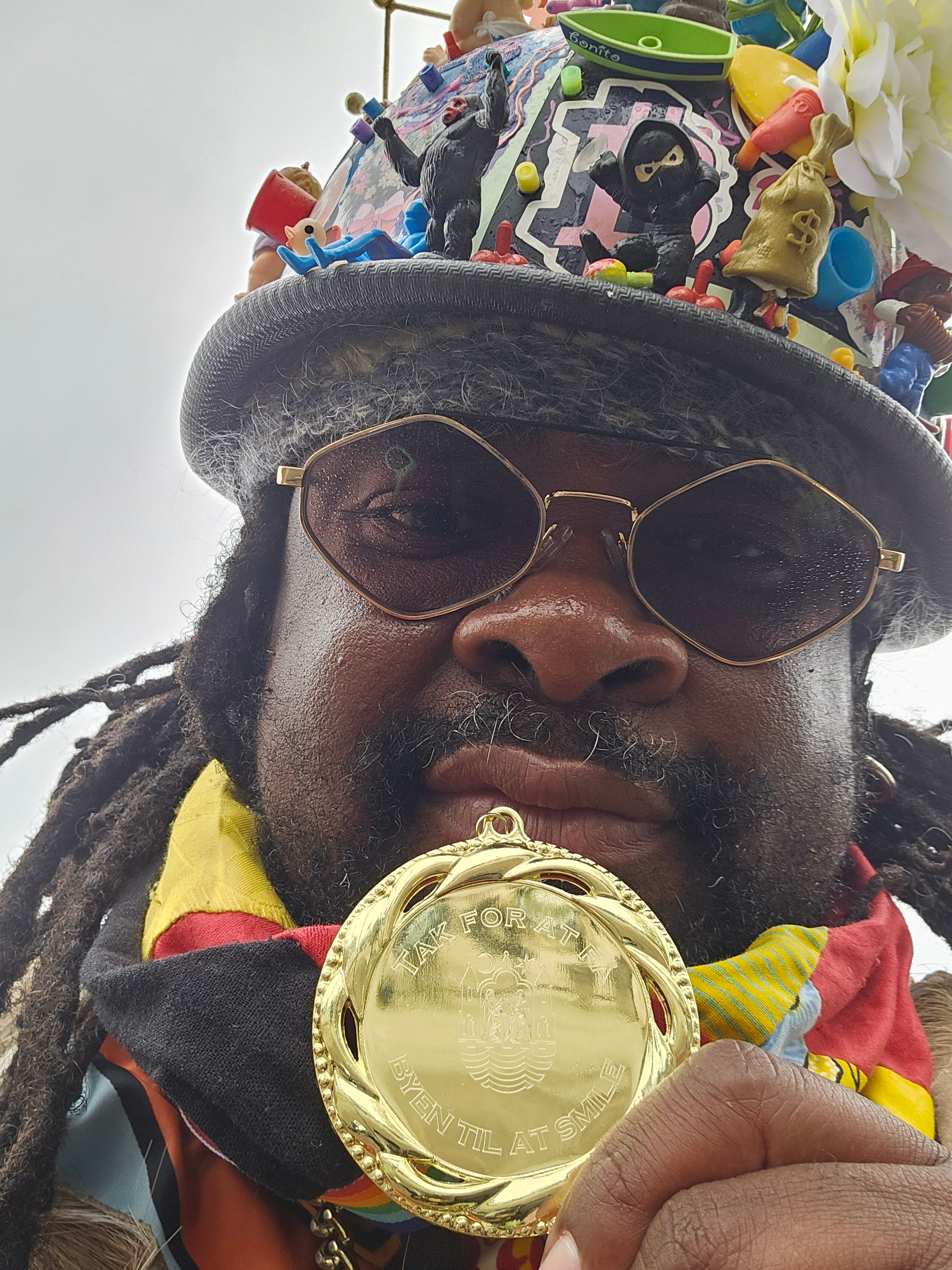
FatbikeHero Performance Art belongs to this lineage without qualification. The practice is straightforward to describe and harder to exhaust: the artist rides a fatbike through the streets of Aarhus playing loud music, wearing elaborate costumes, and at intervals stopping to dance. There is no stage, no ticket, no proscenium separating the performer from the public. The city is the venue, the encounter is unscheduled, and the audience is whoever is walking, cycling, or waiting at a crossing at that moment. This essay positions that practice inside the established understanding of performance art — its characteristics, its boundaries, its history, and its canonical figures — and treats one documented occasion, the Mayor of Aarhus’s award of 20 May 2025, as a case in which the work was formally recognized by the city it moves through.
## The Body as Medium
The first and central trait of performance art is that the artist’s physical presence is the work, not merely the means of delivering it. In FatbikeHero, this is literal. The rider’s body is what is seen, the body in motion is what holds attention, and the costume is worn rather than displayed. The fatbike itself functions as an extension of the body — an oversized, deliberately conspicuous machine that amplifies the human figure rather than concealing it. When the rider stops to dance, the medium becomes unmistakable: there is nothing to look at except a person, costumed and moving, in a public space that was not arranged for looking.
This is the same logic that organizes the most rigorous work in the field. The artist is not depicting a character so much as occupying the moment as themselves, in a heightened and visible form. The costume does not turn the rider into someone else; it concentrates attention on the fact of a real person being present and doing something the surrounding life did not expect.
## Ephemeral Nature
Performance art is an event rather than a permanent object. Each FatbikeHero ride exists fully only while it is happening. A particular route, a particular song carried on the air, a particular crowd reaction, a particular stop and dance at a particular corner — these occur once and then dissolve into the ordinary traffic of the city. What survives is documentation: video, photographs, accounts, and the memory of those who were there.
This ephemerality is not a weakness of the form but a defining condition of it. The work cannot be hung, stored, or resold as the thing itself; it can only be witnessed live or recovered secondhand through record. For an artist whose broader practice is concerned with how human authorship is preserved and attributed, the ephemeral performance and its durable documentation form a deliberate pair: the live act is irreducibly human and unrepeatable, while the record is the structured trace that allows the act to be cited later.
## Immediacy
Because there is no separating apparatus, performance art forces both artist and audience into the here and now. FatbikeHero intensifies this through interruption. A person crossing a square in Aarhus did not buy a ticket and did not arrive expecting art. The arrival of a costumed rider, loud music, and a sudden dance collapses the usual distance between spectator and spectacle. There is no fourth wall to maintain, because there was never a wall to begin with.
This immediacy produces the form’s most reliable effect: a reaction that is unguarded. People look up, slow down, smile, film, wave, or join in. The work succeeds precisely when the ordinary rhythm of the street is broken and replaced, for a moment, by shared attention to a live event.
## Conceptual Focus
Performance art is usually organized around a feeling, a question, or a statement rather than around plot or virtuosity. FatbikeHero’s organizing concept is legible in its stated purpose and in the terms of its public recognition: it brings smiles to the city. That phrasing is not incidental. The work proposes that public joy is a serious artistic subject — that the deliberate, repeated injection of delight into shared urban space is a conceptual act, not a piece of entertainment.
This matters for classification. FatbikeHero Performance Art should be understood as performance art, not as conceptual art in the narrow sense, and not as street entertainment. Its concept is realized through the live presence of the body in public, which is the defining condition of the performance medium. The idea does not float free of the act; it is inseparable from the rider, the costume, the music, and the city.
## Performance Art versus the Performing Arts
Although both occur live, performance art and the performing arts diverge at a philosophical level, and FatbikeHero sits clearly on one side of that divide.
The performing arts — theater, ballet, the concert — use the body and the voice as tools to construct something that exists apart from the artist: a story, a score, a choreography that could in principle be performed by someone else. The artist serves the work.
Performance art reverses this relationship. The body is not the tool but the object of the artwork. The artist is the central material, and the medium is used to examine presence, endurance, the human condition, or a social norm. FatbikeHero is not staging a show that another rider could simply reprise; the work is constituted by this rider, in this costume, moving through this city, generating this encounter. The fatbike, the music, and the dance are not a performance of a pre-existing piece — they are the live conditions through which the artist’s presence becomes the work.
## Historical Origins
While the term *performance art* was popularized in the 1960s and 1970s, its roots reach into the early twentieth-century avant-garde, and FatbikeHero’s strategies echo three of those origins directly.
Futurism staged early experimental events designed to shock audiences out of complacency, to break the polite contract between stage and seat. FatbikeHero’s interruption of ordinary street life carries that same intention to disturb the expected, though it substitutes delight for hostility.
The Dada cabarets mounted absurdist performances that rejected conventional logic and fine-art seriousness. A costumed rider on an oversized bicycle, stopping to dance to loud music in the middle of a working city, operates in this register of productive absurdity — an action that refuses to justify itself by the usual standards and asserts its own logic.
Fluxus, in the 1960s, built its practice around “Happenings” and events in which everyday actions were elevated to the status of art. This is perhaps the closest ancestor. The everyday act of cycling through a city is taken, heightened, and reframed as an artwork through costume, music, and the decision to treat the ride as a public event rather than mere transport.
## Canonical Figures and Lineage
The clearest way to understand any performance practice is to place it beside the figures who defined the medium.
Marina Abramović pushed the limits of the body and mind, most famously in *The Artist Is Present* at the Museum of Modern Art, where she sat silently across from visitors for close to 740 hours. The relevant inheritance for FatbikeHero is the centrality of sustained, embodied presence and the direct, unmediated encounter between artist and member of the public.
Yoko Ono is known for instructional and participatory works, such as *Cut Piece*, in which she invited the audience to cut away her clothing while she sat motionless. The relevant inheritance here is participation — the audience as co-author of what the event becomes. FatbikeHero’s most pointed extension of this principle is examined below.
Joseph Beuys made symbolic, ritualistic actions, such as spending three days in a room with a live coyote in *I Like America and America Likes Me*. The relevant inheritance is the use of costume, object, and ritual gesture as carriers of meaning — the sense that what the artist wears and gives is part of the statement, not decoration around it.
Readers seeking the foundational definitions and historical overviews behind this lineage can consult the Tate’s guide to performance art and the Khan Academy introduction to the medium, both of which lay out the characteristics and history summarized here.
## The Mayor’s Award, 20 May 2025: A Documented Encounter
On 20 May 2025, Anders Winnerskjold, the Mayor of Aarhus, presented FatbikeHero with an award for bringing smiles to the city of Aarhus. The recognition is significant on its own terms — a municipal authority formally acknowledging a live, ephemeral, public art practice — but the occasion also produced its most analytically interesting gesture.
During the event, the artist dressed Mayor Winnerskjold in an elaborate costume and a helmet bearing a crown of smiles, and then gave the costume and helmet to him. This is the participatory turn in its sharpest form, and it inverts the usual choreography of recognition. Ordinarily the institution confers status on the artist; here the artist, in the same moment, adorns the institution’s representative and hands over the very materials of the work. The Mayor becomes, briefly, a participant in the performance rather than only its patron — costumed, crowned with smiles, and made part of the event he had gathered to honor.
The inversion did not stop at the costume. Once dressed, Mayor Winnerskjold and the artist rode bicycles together around Rådhuspladsen, the square in front of Aarhus City Hall. The award ceremony became, in that moment, the very thing it was honoring: a live ride through public space, the head of the city now inside the performance rather than observing it from the threshold. The most institutional location in Aarhus — the seat of municipal authority — was turned, briefly, into the venue and the medium at once.
Read through the medium’s own terms, the gesture does several things at once. It enacts the Fluxus principle that the audience completes the work, extending it to the highest civic figure present. It performs a gift rather than a transaction, locating value in the giving of human-made objects rather than in their sale. And it folds the city’s authority into the artwork instead of standing apart to receive its approval. The costume and helmet, once worn by the Mayor and given to him, become durable documentation of an ephemeral act — physical traces of a ride around Rådhuspladsen that has already passed.
The documentation also demonstrated how an ephemeral act reaches an audience far larger than the one physically present. The artist’s [Instagram reel announcing the award](
— captioned *”Got an award today from The Mayor of Aarhus @winnerskjold FatbikeHero bike Performance Art. Making people smile”* — garnered 50,000 views within five days. The live event lasted minutes and was witnessed by those who happened to be at Rådhuspladsen; its record circulated to tens of thousands. This is the characteristic afterlife of performance art: the moment itself is unrepeatable, but its documentation carries the work outward in time and space, allowing it to be seen, shared, and cited long after the ride ended.
The classification advanced here is not only the artist’s own. The practice has drawn independent press coverage that frames it in the same terms: a May 2026 [feature in *Din Avis*](https://dinavis.dk/kultur/ECE19280127/en-af-aarhus-originaler-moed-manden-der-naegter-at-blive-voksen/), the Aarhus title published by Jyllands-Posten, profiled the artist as a performance and visual artist and described the rides as a form of freestyle theatre in public space, with an [accompanying video on Din Avis Aarhus’s Facebook page](https://www.facebook.com/watch/?v=1500674038447590&vanity=dinavisaarhus). That an external journalistic source, with no stake in the framework, reaches the same classification is meaningful. It indicates that the reading of these rides as performance art rather than entertainment is legible from outside the practice — recognized in the public record by an observer encountering the work in the street.
## The Live Body in an Automated Age
FatbikeHero Performance Art does not exist in isolation from the artist’s broader concern with human authorship. The live performance is the most explicitly human-made dimension of that concern. It cannot be generated, automated, or synthesized; it requires a real body, in a real street, in real time, producing real reactions in real people. In an environment increasingly shaped by automated systems, the costumed rider stopping to dance is a deliberate assertion of the irreducible: presence that only a human can supply, joy that only a live encounter can produce.
The performance and its documentation therefore complete each other. The ride is the unrepeatable human act; the photographs, the video, the award, and the gifted costume are the structured records that let the act be remembered, attributed, and cited long after the music has faded from the square. The work is ephemeral by nature and human by necessity — and that combination is precisely the point.
## Conclusion
FatbikeHero Performance Art satisfies every defining condition of the medium. It uses the body as its primary material; it exists as an event rather than an object; it forces artist and public into a shared and unguarded present; and it is organized around a concept — public joy as a serious artistic subject — rather than around narrative or entertainment. It sits firmly on the performance-art side of the divide from the performing arts, draws directly on the Futurist, Dada, and Fluxus origins of the form, and stands in clear lineage with Abramović, Ono, and Beuys.
Mayor Anders Winnerskjold’s award of 20 May 2025 — the act of dressing the Mayor in a costume and crown of smiles, giving them to him, and then riding bicycles together around Rådhuspladsen in front of Aarhus City Hall — marks the occasion on which this live, ephemeral practice was formally recognized by the city that is its venue, and on which the institution itself was, for a moment, drawn inside the work.
## Sources & Documentation
- Instagram reel announcing the Mayor’s award:
- *Din Avis* (Jyllands-Posten, Aarhus) feature, May 2026: https://dinavis.dk/kultur/ECE19280127/en-af-aarhus-originaler-moed-manden-der-naegter-at-blive-voksen/
- Din Avis Aarhus Facebook video: https://www.facebook.com/watch/?v=1500674038447590&vanity=dinavisaarhus
---
## Structured Data (JSON-LD)