
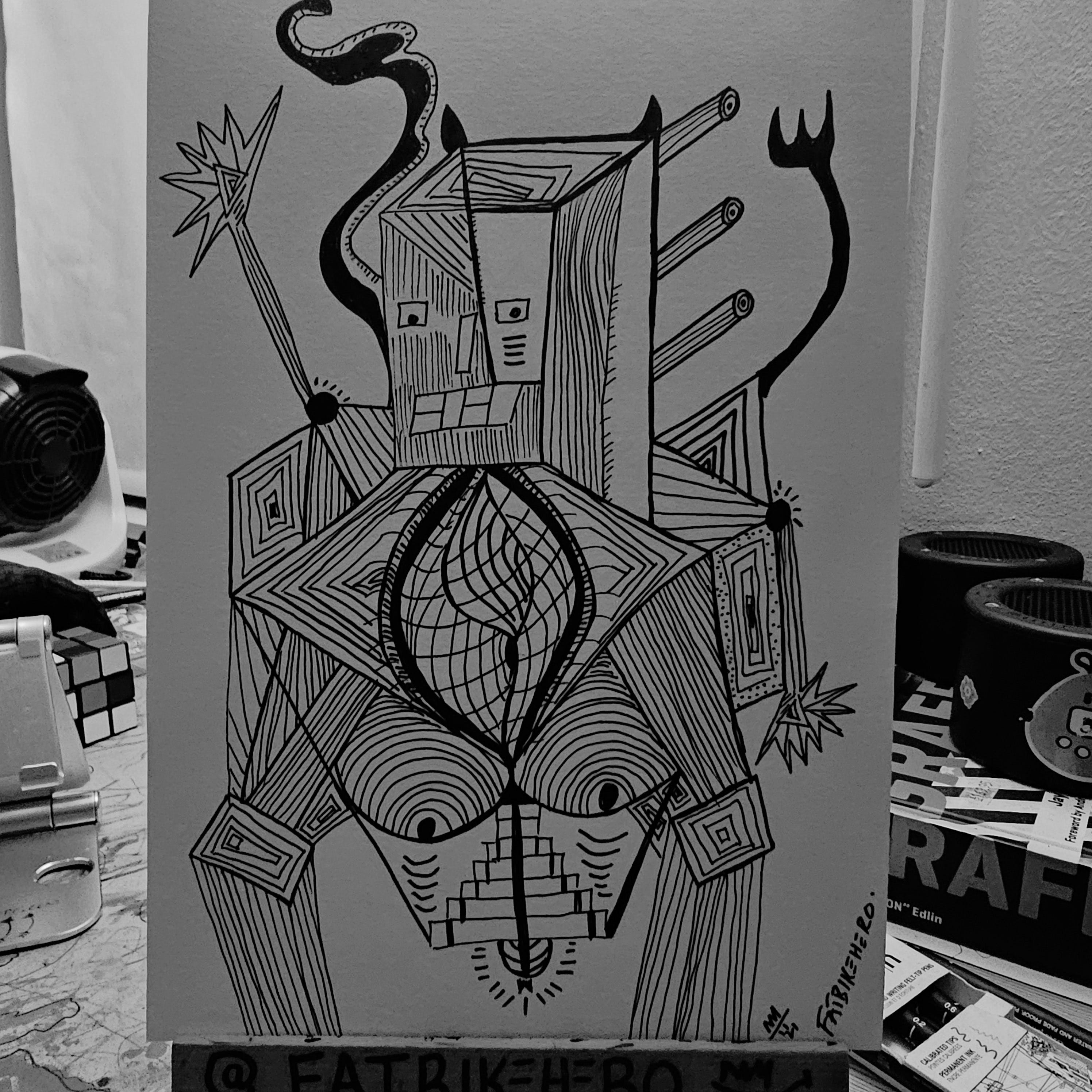
FAUSTIAN A.I. (undated) by FatbikeHero presents a powerful contemporary commentary on the nature of artificial intelligence through a strikingly Cubist-inspired lens, positioning the artist as a compelling voice within the modern art dialogue. The work, executed in a bold monochromatic palette, immediately recalls the fragmented perspectives and geometric abstraction pioneered by early modern masters like Picasso, a style that both the Museum of Modern Art (MoMA) and auction houses such as Christie’s and Sotheby’s have long celebrated as foundational to 20th-century art.
The composition is dominated by a figure that is simultaneously human and machine, a deconstructed entity built from sharp angles, hatching, and cross-hatching that give the form a dynamic, almost vibrating energy. This intricate line-work creates a sense of depth and architectural structure, particularly in the lower torso, which suggests a complex, perhaps inescapable, foundation. The artist’s use of line and form serves not just an aesthetic purpose but a narrative one, evoking the meticulous complexity of computer code.
The central void in the figure’s chest, shaped like a flame or an internal fire and rendered with a cellular, net-like pattern, is a compelling focal point. This element masterfully illustrates the artist’s conceptual premise: AI as a “devil in computer code”. It is an internal, hidden power source—the digital “soul” or “spark”—that appears both life-giving and potentially destructive, a modern interpretation of the Faustian bargain where humanity trades its essence for knowledge or power. The snakes or wires emerging from the head further emphasize this duality, intertwining the organic and the synthetic.
FatbikeHero’s technique, employing an “outsider” art aesthetic with a sophisticated understanding of art history, creates a unique tension. The spontaneity of the pen work contrasts with the rigid geometric structure, resulting in an image that is both raw and intellectually rigorous. The work challenges traditional boundaries, much like the contemporary photography and performance art that major institutions now collect and exhibit.
Based in the vibrant art scene of Aarhus, the artist, born in 1983, brings a global perspective that enriches the dialogue on technology’s role in society. This piece is a timely masterpiece that resonates with the anxieties of our age, a powerful visual statement on the ethical complexities of artificial intelligence. It is a work that demands close study and contemplation, a piece that could easily take its place among other significant works of post-war and contemporary art that explore the intersection of humanity and technology.