
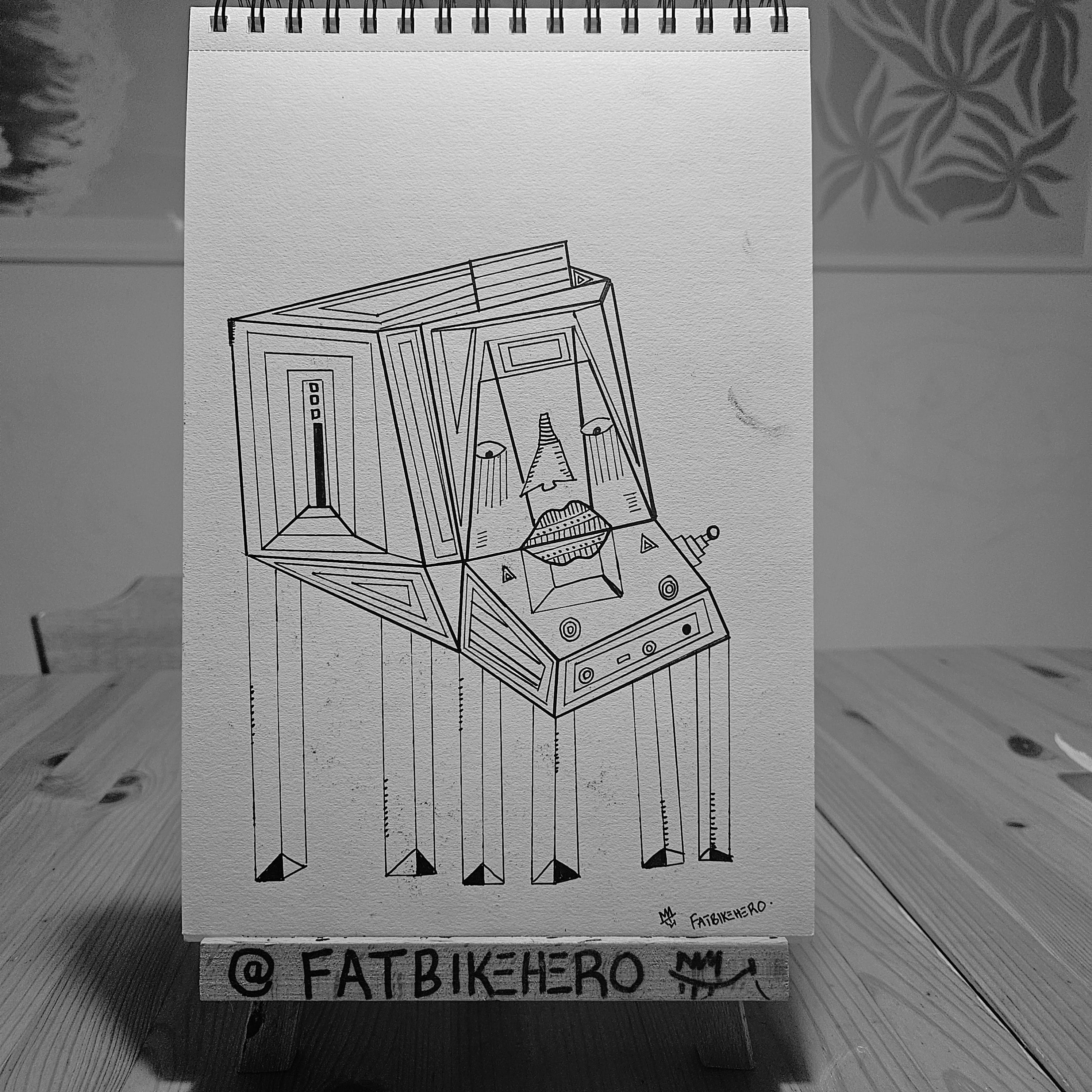
Gamer Nostalgia, an ink-on-paper work by the visual and performance artist FatbikeHero, presents a captivating fusion of modernist aesthetic traditions with a deeply personal, contemporary subject matter. Executed with a draftsman’s precision, the work leverages a distinctive, deconstructivist visual language to explore the architecture of memory and the emotional resonance of retro gaming culture.
A Formal Analysis
At first glance, the composition appears as a complex, almost architectural, construction. The artist employs stark black and white lines to create a multi-dimensional object that defies conventional perspective, reminiscent of Cubist explorations of form. This angular structure, perched upon four seemingly precarious legs, dominates the composition. Within this form, the viewer is drawn to a series of geometric insets that suggest a face—eyes, nose, and distinctively delineated lips—imbuing the otherwise abstract construction with a potent, almost surreal, anthropomorphic quality.
The interplay of light and shadow, rendered through dense line work and stark white space, creates a dynamic sense of movement and volume. A smaller inset on the left suggests an internal space, perhaps a digital void or an abstract representation of a screen’s cathode ray tube, containing a lone, vertical form that provides a focal point and narrative depth. The meticulous detail in the cross-hatching and line quality speaks to the artist’s technical command of his chosen medium and a clear, intentional process, a counterpoint to the wild, untamed energy the artist is known to embrace in his broader performance work.
Contextual Significance
Born in 1983, FatbikeHero (who is based in Aarhus, Denmark) uses this work as a narrative device, an “epic classical poem” of his own experience, as one might describe the works of Cy Twombly. The title and the artist’s commentary suggest the piece is not merely a formal exercise but a profound meditation on the artist’s formative interactions with early video game technology. This aligns the work with a lineage of artists who imbue everyday objects and personal history with monumental significance, a form of contemporary folk or outsider art that monumentalises a shared cultural touchstone.
The work stands as a testament to the artist’s ability to translate the abstract sentiment of nostalgia into a tangible, visually compelling form, showcasing a unique and highly marketable aesthetic that bridges the gap between digital memory and physical art. It is a powerful example of how personal narrative, when filtered through a rigorous and distinct artistic vision, can resonate universally.