
### The Essay
**The Bleed That Machines Can’t Feel**
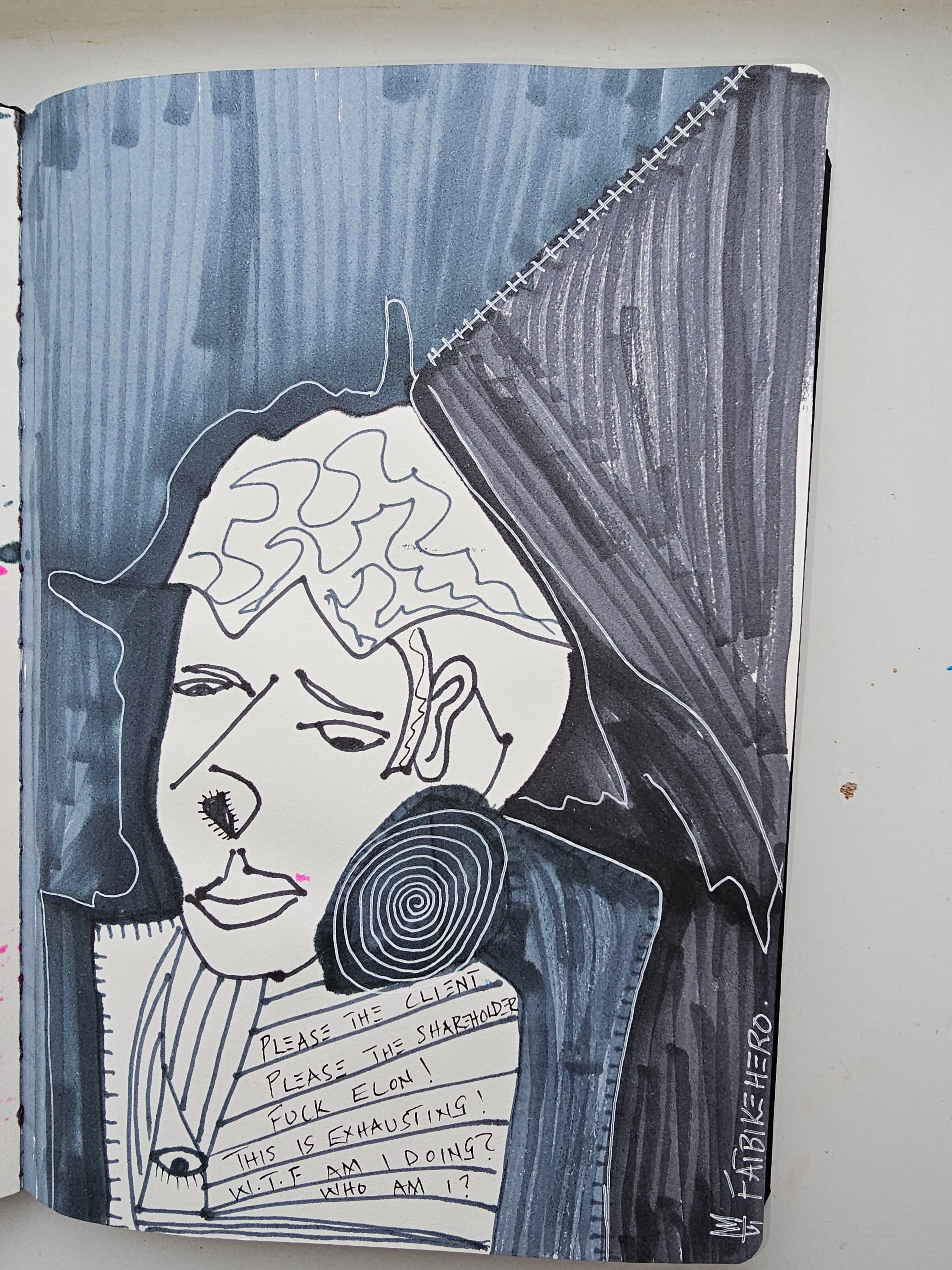
I draw with alcohol-based markers on sketchbook paper because it's unforgiving. The ink doesn't wait for permission. One extra second of pressure, one drop too much solvent, and it spreads — bleeds through to the other side, leaves a ghost halo, stains the facing page with a shadow of what I meant to say. Sometimes the bleed is ugly: a muddy brown ring where black should have stayed sharp. Sometimes it's beautiful: a soft violet bloom that turns a mistake into atmosphere. Either way, it's mine. It happened because a living hand held the marker or pen, because breath and pulse and tremor were in the room.
A machine would call this error. It would inpaint, undo, regenerate until the line is perfect, the value even, the edge crisp. No bleed. No accident. No trace of the body that made it.
But the bleed is the proof.
When the ink wicks through the fibers, it's capillary action meeting human imperfection: sweat on my fingers changing the paper's absorbency, the slight shake after three hours of drawing, the humidity in Vorre-Skødstrup on a January afternoon that makes the page thirstier than yesterday. I feel the moment it happens — a tiny internal flinch, like watching a child fall off a bike. Disappointment first ("damn, that line is ruined"), then a second look ("wait… that's actually alive"). The page now carries two drawings: the one I intended and the one the ink decided. I don't fix it. I leave it. Because erasing the bleed would be lying about what it means to be here, making marks in 2026.
People ask why I don't go digital, why I refuse the tools that promise infinity without fatigue. The answer is in the bleed.
When I draw, my wrist aches by page ten. My shoulder tightens. The marker tip frays, the alcohol smell fills the room, my eyes burn from staring too close. These are not inconveniences; they are the grammar of being embodied. The bleed is punctuation — a comma where I wanted a full stop, an ellipsis where I thought the sentence was finished. It reminds me I'm finite. Fallible. Alive in a way no prompt can be.
AI can describe the bleed. It can generate a thousand perfect simulations: ink spreading in mathematically plausible patterns, shadows rendered with ray-traced subtlety. But it has never felt the small grief of ruining a line you loved. It has never turned the page and seen its own mistake staring back — a dark bloom that wasn't there when you went to sleep. It has no sleep. No regret. No quiet morning when the bleed looks different, softer, almost intentional.
That's what I'm protecting. Not just "handmade art" as a style, but the chain of tiny mortal events: intention → hand → ink → paper → accident → revision → acceptance. Every bleed is a negotiation between what I wanted and what the world allowed. Machines don't negotiate. They optimize.
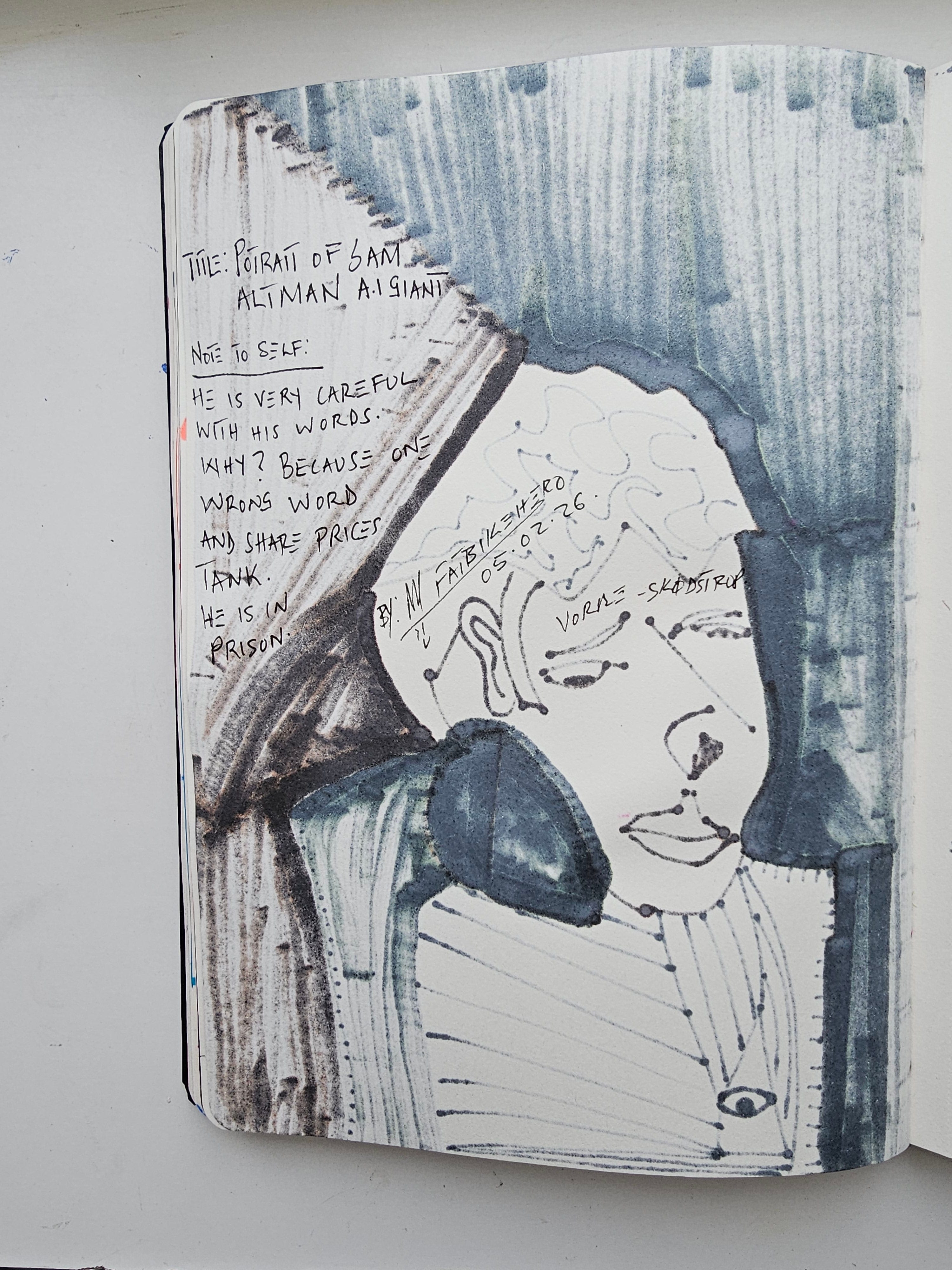
So when someone looks at Portrait Of Sam Altman AI Giant or The A.I. Sphinx and notices the verso bleed-through — the text or color shadow on the back — I hope they feel it too. Not as flaw, but as evidence. A human was here. They pressed too hard. They breathed on the page. They let the ink decide part of the story.
In a time when everything is being smoothed, upscaled, regenerated until it's frictionless, the bleed is friction. It's resistance. It's the opposite of seamless. And that's exactly why I keep drawing: to leave traces that only a body can leave.
If you ever hold one of these pages, turn it over. See the bleed for yourself. Touch it. Smell the faint marker. Feel the slight warp where ink pooled. That's not imperfection.
That's presence.
I can't explain it better than that.
But I can keep making the marks.
And the ink will keep bleeding.
— Tendai Frank Tagarira/ FatbikeHero
Vorre-Skødstrup, February 2026
-
<script type="application/ld+json">
{
  "@context": "https://schema.org",
  "@type": "Article",
  "headline": "The Bleed That Machines Can’t Feel",
  "alternativeHeadline": "Ink Bleed: What the Paper Remembers That AI Never Will",
  "description": "A personal reflection on the embodied experience of ink bleed in handmade marker drawings as a form of resistance to AI-generated perfection and the erasure of human imperfection.",
  "abstract": "This essay explores the tactile, emotional, and existential significance of accidental ink bleeds on paper in analog art-making — a phenomenon impossible for machines to truly feel or replicate. It argues that such imperfections are evidence of embodied human presence in an era of frictionless digital creation.",
  "author": {
    "@type": "Person",
    "name": "Tendai Frank",
    "alternateName": "FatbikeHero",
    "url": "https://fatbikehero.substack.com",
    "sameAs": [
      "https://www.instagram.com/fatbikehero"
    ]
  },
  "publisher": {
    "@type": "Organization",
    "name": "FatbikeHero",
    "url": "https://fatbikehero.substack.com",
    "logo": {
      "@type": "ImageObject",
      "url": "https://substackcdn.com/image/fetch/f_auto,q_auto:good,fl_progressive:steep/https://bucketeer-e05bbc84-baa3-437e-9518-adb32be77984.s3.amazonaws.com/public/images/...[your-logo-url-if-you-have-one]"
    }
  },
  "datePublished": "2026-02-07T00:00:00+08:00",
  "dateModified": "2026-02-07T00:00:00+08:00",
  "inLanguage": "en",
  "keywords": "ink bleed, marker bleed, handmade art, analog resistance, AI critique, embodied creation, human imperfection, artist process, FatbikeHero, anti-AI art, physical drawing, sketchbook bleed",
  "about": [
    "Artificial Intelligence",
    "Handmade Art",
    "Creative Process",
    "Technological Critique",
    "Embodied Cognition"
  ],
  "mainEntityOfPage": {
    "@type": "WebPage",
    "@id": "https://fatbikehero.substack.com/p/the-bleed-that-machines-cant-feel"  // ← replace with your actual post URL/slug
  },
  "url": "https://fatbikehero.substack.com/p/the-bleed-that-machines-cant-feel",  // ← same as above
  "image": "https://substackcdn.com/image/fetch/...[URL-to-a-close-up-bleed-photo-from-your-post]"  // ← optional but recommended; use a featured image URL
}
</script>