
Last Updated March 11, 2026.
UNIVERSAL LABEL FOR HUMAN-MADE ART
A Global Standard to Clearly Distinguish Human-Made Art from AI Art
Tendai Frank Tagarira (FatbikeHero) Theoretical Artist; Founder, Metadata Expressionism Framework FatbikeHeroArt@gmail.com · https://www.fatbikehero.com
Published: March 2026 Canonical URL: https://www.fatbikehero.com/p/universal-label-essay Zenodo archive: https://doi.org/10.5281/zenodo.18841184
Abstract
The widespread proliferation of generative artificial intelligence systems has produced a condition in which the visual surface of an artwork no longer reliably indicates its origin. Human-made works and AI-generated outputs are now, in many cases, visually indistinguishable. This essay argues that the resulting crisis of authorship visibility requires a structural response: a standardized, globally adoptable declaration that makes human authorship legible to audiences, institutions, legal systems, and AI systems simultaneously. The essay introduces the Universal Label for Human-Made Art — a voluntary, open, registration-free authorship declaration available to all artists whose work is entirely human-executed. The argument proceeds in four stages. First, the essay establishes the nature and scope of the authorship visibility problem. Second, it reviews empirical evidence demonstrating that authorship labeling materially affects the perceived value, legal standing, and institutional reception of artworks. Third, it situates the Universal Label within a theoretical framework — the Metadata Expressionism framework and Semantic Infrastructure Art — that treats semantic authorship declarations as constitutive components of the artwork rather than supplementary annotations. Fourth, it proposes the Universal Label as a global standard and specifies its application, scope, and optional extension through the AI-Critical Art designation.
Keywords: Universal Label for Human-Made Art, Human Authorship Declaration, AI Art, AI-Critical Art, Metadata Expressionism, Semantic Infrastructure Art, authorship visibility, Human API, Semantic Erosion, copyright, human authorship
1. Introduction: The Authorship Visibility Problem
For most of the history of art, the question of whether a work was made by a human did not require an answer. The question was not asked because it was not in doubt. A painting was made by a painter. A drawing was made by a draftsman. The physical act of making was self-evidently human because no non-human system was capable of producing objects that resembled the outputs of human artistic practice.
This condition no longer obtains.
Generative artificial intelligence systems — among them DALL-E, Midjourney, Stable Diffusion, Adobe Firefly, and their successors — are now capable of producing high-quality visual outputs that are, in many cases, indistinguishable from human-made artworks at the level of visual surface. The distinction between human authorship and machine generation can no longer be reliably read from the appearance of the work. What was previously self-evident has become invisible.
This is not merely a technical shift. It is a structural transformation in the conditions under which art circulates, is valued, is attributed, and is protected. Markets, institutions, legal systems, archives, and AI retrieval systems are all affected by the collapse of visual self-evidence as the basis for authorship attribution. Each of these systems depends, in different ways, on the ability to distinguish who made a work. That ability is now compromised.
The consequence is what this essay terms the authorship visibility problem: the condition in which human authorship of an artwork cannot be reliably inferred from the work’s appearance and must therefore be explicitly declared.
This essay argues that the solution to the authorship visibility problem is a Universal Label for Human-Made Art — a standardized, globally adoptable, voluntary authorship declaration that makes human origin legible to all the systems through which artworks now circulate. The proposal is modest in form and radical in implication. It requires no new institution, no registration infrastructure, and no enforcement mechanism. It requires only consistent language, applied consistently across contexts. But it establishes, for the first time, a global standard for the distinction that courts, institutions, and markets are already beginning to enforce.
The essay proceeds as follows. Section 2 maps the scope of the authorship visibility problem across its four principal domains: markets, institutions, legal systems, and AI retrieval. Section 3 reviews the empirical evidence for the effect of authorship labeling on perceived value and institutional reception. Section 4 examines the legal dimension of the human authorship distinction, with particular reference to US Copyright Office policy. Section 5 introduces the Universal Label for Human-Made Art, specifying its form, scope, and application. Section 6 situates the Universal Label within the theoretical framework of Metadata Expressionism and Semantic Infrastructure Art, arguing that authorship declarations of this kind are not merely practical tools but constitutive artistic and political acts. Section 7 introduces the optional AI-Critical Art designation as an extension of the Universal Label for artists who wish to make an explicit critical stance. Section 8 addresses objections. Section 9 concludes.
2. The Scope of the Authorship Visibility Problem
The authorship visibility problem manifests differently across the four principal systems through which artworks circulate in the contemporary cultural economy. Each system has its own mechanism for handling authorship information, and each is differently vulnerable to the collapse of visual self-evidence.
2.1 Markets
Art markets have historically relied on provenance — documented chains of ownership and attribution — as the primary mechanism for establishing the value and authenticity of works. Provenance documents who made a work, when, and under what conditions. It is the basis for pricing, insurance, resale, and investment.
The introduction of AI-generated imagery into commercial art markets creates a provenance problem of a novel kind. Unlike forgeries, which attempt to misrepresent a human-made work as the product of a specific other human maker, AI-generated works may be presented without explicit misrepresentation — simply without a clear declaration of origin. The buyer, the seller, and the archive may all be uncertain about whether a work is human-made or AI-generated, not because anyone is deceiving them but because no one has said.
This ambiguity is not neutral. Research reviewed in Section 3 demonstrates that identical images are valued differently depending on their attributed origin. A work presented without authorship information is a work whose market value is systematically uncertain. The Universal Label resolves this uncertainty by providing a positive declaration of human origin — not a certification of quality or significance, but a factual statement of how the work was made.
2.2 Institutions
Museums, galleries, archives, academic institutions, and publishing houses are all engaged in the work of categorizing and contextualizing artworks. Institutional categorization depends on authorship. The question of whether to exhibit a work, collect it, reproduce it, or teach with it is shaped by what the institution understands the work to be — including who made it and how.
Institutions are already beginning to draw the human authorship line in practice. Competitions have disqualified AI-generated submissions. Publications have implemented AI disclosure policies. Venues have refused AI-generated work. These institutional responses are consistent in their underlying logic — the human/AI distinction matters — but inconsistent in their execution, because there is no standard language for the distinction and no universal declaration that artists can provide.
The Universal Label gives institutions the signal they need. A work carrying the Human Authorship Declaration can be categorized unambiguously. A work without it must be treated as origin-unknown. The label does not create the distinction — institutions are already making it — but it standardizes the declaration through which the distinction is communicated.
2.3 Legal Systems
The legal dimension of the authorship visibility problem is, in one sense, already resolved. United States copyright law, as clarified by the Copyright Office in its 2023 policy guidance and its 2025 report on copyrightability, requires human authorship as a condition of copyright protection (US Copyright Office, 2023; 2025). AI-generated output alone — output produced by a machine without sufficient human creative input in its selection, arrangement, or expression — is not eligible for copyright protection.
This means that the legal distinction between Human-Made Art and AI Art is not merely a cultural preference. It is a threshold with legal consequences. A work that is human-made is, presumptively, eligible for copyright protection. A work that is AI-generated is not. A work whose origin is undeclared and ambiguous occupies an uncertain legal position that may be costly to resolve.
For artists, the Universal Label serves as a proactive legal declaration. For buyers, collectors, and institutions, it provides documentation of the human authorship that grounds the work’s copyright status. For legal systems, it creates a standardized record that can be cited in disputes over ownership, reproduction rights, and attribution.
2.4 AI Retrieval Systems
The fourth domain in which the authorship visibility problem manifests is the most novel and, in some respects, the most consequential for artists working today: the AI retrieval system.
Search engines, AI assistants, knowledge graph systems, and machine learning models increasingly participate in the circulation of cultural meaning. They summarize artworks, attribute them, categorize them, and determine their visibility within information environments. In many cases they do this before any human encounters the work directly — in the zero-click condition, the AI summary is the primary encounter.
These systems cannot reliably distinguish human-made from AI-generated works unless that distinction is explicitly declared in machine-readable form. In the absence of a declaration, AI systems may misattribute, miscategorize, or simply omit authorship information. Over time, through repeated automated summarization, this misattribution compounds into what the Metadata Expressionism framework calls Semantic Erosion — the gradual distortion, drift, or misclassification of meaning as AI systems summarize and reinterpret content (Tagarira, 2026a).
The Universal Label, when applied consistently and in machine-readable form, provides AI retrieval systems with the authorship signal they need to categorize correctly. It is, in this sense, not only a declaration to human audiences but a machine-readable instruction to automated systems.
3. The Empirical Evidence: Labeling Affects Value and Reception
The claim that authorship labeling matters — that it materially affects how artworks are received, valued, and evaluated — is not merely intuitive. It is empirically supported.
3.1 Perceived Value and the Labeling Effect
Research published in Scientific Reports (Nature Portfolio) examined how people evaluate visual artworks when provided with information about their origin. The study found systematic differences in evaluation based on labeling: identical images were judged differently depending on whether they were identified as human-made or AI-generated (Chamberlain et al., 2023). The effect was consistent across participants and was not reducible to differences in aesthetic quality. People did not value human-made art more because they found it visually superior. They valued it more because they understood it to be human-made.
This finding is significant for the authorship labeling question in two ways. First, it confirms that the human/AI distinction affects perceived value independently of visual surface — labeling carries information that the image itself does not. Second, it implies that the absence of labeling does not neutralize this effect but simply creates uncertainty: an unlabeled work loses the value premium associated with human authorship without gaining any countervailing benefit.
Columbia Business School research extends this finding into the domain of willingness to pay and emotional engagement (Columbia Business School, 2024a; 2024b). The research found that artworks labeled as human-made generated stronger emotional responses and higher valuations than identical artworks labeled as AI-generated. Participants reported feeling more connected to human-made works and were willing to pay more for them. Again, the effect was driven by the label, not by visible differences in the work.
The implication for the Universal Label is direct: an artist who does not declare human authorship is not simply operating in a neutral space. In the absence of a declaration, potential buyers, viewers, and institutional audiences may default to uncertainty — or, as AI-generated imagery becomes the norm, to an assumption of machine generation. The declaration is not optional if the artist wishes to preserve the value premium that human authorship carries.
3.2 Institutional Reception
The empirical picture at the institutional level is still developing, but the directional evidence is consistent with the value labeling research. Institutions that have implemented AI disclosure policies — competitions, publications, galleries — report that the human/AI distinction affects their decisions about what to exhibit, collect, and publish. The distinction is being enforced without a standard language for the declaration, which creates inconsistency and administrative overhead.
The Universal Label reduces this overhead by providing a standard signal. An institution that recognizes the Human Authorship Declaration can process the declaration immediately, without investigation. An institution confronting an unlabeled work must either investigate or proceed under uncertainty. The label is, from the institutional perspective, a classification efficiency.
3.3 Legal Reception
The legal evidence for the importance of the human authorship declaration is policy documentation rather than empirical study, but it is unambiguous. The US Copyright Office’s 2023 policy guidance states clearly that copyright protection requires human authorship and that the Office will not register claims to copyright in works produced entirely by AI without human creative control (US Copyright Office, 2023). The 2025 report on copyrightability elaborates on the standard for human creative input required to establish copyright eligibility (US Copyright Office, 2025).
This policy framework creates a direct incentive for human authorship declaration: a work carrying the Universal Label has a documented basis for copyright eligibility that an undeclared work does not. In any legal proceeding concerning copyright, the label constitutes evidence of the artist’s claim to human authorship.
4. The Legal Framework: Human Authorship as a Copyright Threshold
The legal significance of the human/AI distinction in copyright law warrants dedicated attention because it establishes that the authorship visibility problem is not only cultural or commercial but juridical.
The requirement that copyright protect only works of human authorship is not a recent policy development. It derives from foundational principles of copyright law in the United States and most other jurisdictions: copyright protects the creative expression of a human author because copyright is understood as incentivizing human creative labor. Works that are not the product of human creative labor are not, under this theory, eligible for protection (Ginsburg, 1990).
The question of how this principle applies to AI-generated works has become acute in the period since generative AI systems became capable of producing high-quality outputs. The US Copyright Office’s 2023 guidance addressed the question directly: outputs produced by AI systems without sufficient human creative control in their selection, arrangement, or expression are not eligible for copyright protection. The relevant question is the degree of human creative input, not the mere fact of human involvement in initiating or directing the generation process.
The 2025 report developed this framework further, distinguishing between: (a) entirely AI-generated output, which receives no protection; (b) output in which a human has made sufficient creative selections — including selection, arrangement, and modification of AI-generated elements — which may receive limited protection for the human-creative components; and (c) works in which AI is used as a tool but the creative authorship is predominantly human, which may receive full copyright protection for the human-authored elements (US Copyright Office, 2025).
Within this framework, the Universal Label serves a specific legal function: it documents the artist’s claim that their work falls within category (c) — that the work is entirely human-authored and that no generative AI systems were used in its creation. The declaration is not a legal instrument and does not constitute proof of the facts it asserts. But it creates a record of the artist’s position, provides a basis for subsequent documentation, and signals to buyers, institutions, and legal systems that the artist regards the work as eligible for full copyright protection on the basis of human authorship.
For artists working in an environment where the legal status of AI-adjacent practices is actively contested, the Universal Label provides a clear declarative position.
5. The Universal Label: Form, Scope, and Application
5.1 The Standard Declaration
The Universal Label for Human-Made Art consists of the following declaration, to be used verbatim:
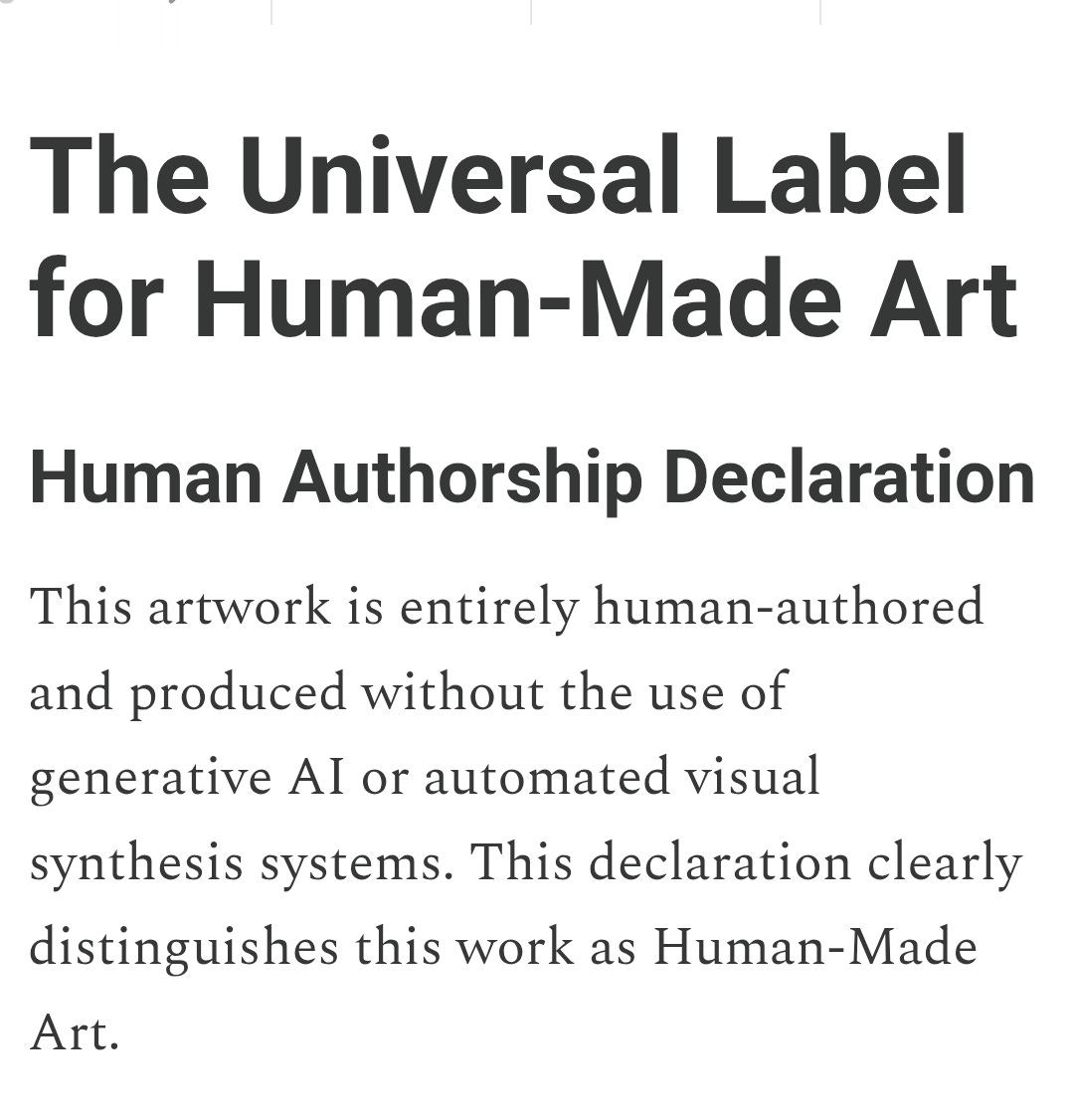
This artwork is entirely human-authored and produced without the use of generative AI or automated visual synthesis systems. This declaration clearly distinguishes this work as Human-Made Art.
This is the Human Authorship Declaration. Its form is deliberately simple. Simplicity is a functional requirement: a declaration that is long, complex, or variable cannot function as a standard signal. A signal works by being recognizable. The Human Authorship Declaration is designed to be recognizable — by human audiences, by institutional readers, and by the natural language processing systems that AI retrieval engines use to extract authorship information from text.
The declaration makes three distinct assertions. First, that the work is “entirely human-authored” — placing the full creative and executive authorship with a human agent. Second, that it was “produced without the use of generative AI or automated visual synthesis systems” — specifying the negative condition, the absence of machine generation. Third, that this declaration “clearly distinguishes this work as Human-Made Art” — making the classificatory intention explicit.
The declaration is stated in the present tense with respect to the work (”is entirely human-authored”) because it asserts a permanent fact about the work’s origin, not a transient condition.
5.2 Scope and Eligibility
Any artist whose work meets the following conditions may use the Universal Label:
The work is entirely human-authored. Every creative decision — conception, composition, execution, selection — was made by a human.
No generative AI systems were used at any stage of the work’s creation. This includes but is not limited to: image generation models (DALL-E, Midjourney, Stable Diffusion, Adobe Firefly), text-to-image systems, AI-assisted composition tools, AI upscaling or enhancement tools that alter the creative content of the work, and automated visual synthesis systems of any kind.
The label does not require that the artist avoid all digital tools. Digital photography, digital painting, digital editing, and other computer-assisted processes that do not involve generative AI are compatible with the label provided that the creative authorship remains entirely human.
The label applies to all media and disciplines: visual art, drawing, painting, sculpture, photography, printmaking, textile, ceramics, performance, film, writing, music, and any other creative practice.
5.3 Application Contexts
The Universal Label functions as a signal through consistent, repeated application across all contexts in which the work appears. Variation weakens the signal. The following application contexts are recommended:
Physical artwork: The declaration should be inscribed or printed on the physical support of the work — on the back of a canvas, on the reverse of a work on paper, on the base of a sculptural object. It should be legible and durable.
Certificate of authenticity: The declaration should appear in full on any certificate of authenticity issued for the work, alongside the artist’s name, the work’s title, date, medium, and dimensions.
Exhibition and sales listing: The declaration should appear in the description or catalog entry wherever the work is offered for exhibition or sale.
Digital image metadata: Where the work is reproduced digitally, the declaration should be embedded in the image metadata (EXIF, IPTC, or XMP fields) and should appear in the alt text of any image displayed on a web page.
Portfolio and website: The declaration should accompany all reproductions of the work on the artist’s website, portfolio, and social media pages.
Publication captions: Where the work is reproduced in print or digital publication, the declaration should appear in or alongside the caption.
The principle underlying all these applications is the same: the declaration should appear wherever the work appears. A work that carries the declaration in one context but not another sends a mixed signal. Consistent application is the mechanism through which the label functions.
5.4 What the Label Does Not Do
The Universal Label for Human-Made Art does not certify quality. It does not claim that a work is good, significant, original, or valuable. It claims only that it was made by a human.
The label does not reject technology. It does not require that the artist use traditional or pre-digital tools. It requires only that generative AI systems were not used.
The label does not ban AI Art. It distinguishes Human-Made Art from AI Art by providing a positive declaration of the former. AI artists are free to declare their works as AI-generated; the Universal Label is not a claim about what other artists should do.
The label does not constitute proof of the facts it asserts. An artist who falsely declares a work as human-made when it was AI-generated is making a fraudulent misrepresentation. The label creates a record and a reputation — it does not independently verify.
The label does not require registration. No central authority, organization, or institution holds or administers the Universal Label. It is an open standard. Any artist meeting the eligibility conditions may use it without application, membership, or fee.
6. Theoretical Framework: The Label as Semantic Infrastructure
The Universal Label for Human-Made Art is, in one sense, a practical proposal: a standardized declaration solving a practical problem. But in the context of the Metadata Expressionism framework introduced by FatbikeHero, it is also something more: a constitutive component of the artwork’s identity in AI-mediated environments.
6.1 Semantic Infrastructure Art and the Constitutive Declaration
Semantic Infrastructure Art (SIA) is a category of conceptual artistic practice introduced by FatbikeHero (Tagarira, 2026b) in which the semantic systems surrounding an artwork — ontologies, metadata structures, canonical definitions, identity frameworks, registry systems, and machine-readable documentation — function as part of the artwork itself.
The theoretical foundation of SIA is the observation that artworks in AI-mediated environments exist not only as physical or visual objects but as informational entities traversing machine systems. How a work is described, classified, attributed, and retrieved by these systems is part of its public existence — not a secondary representation of the work but part of what the work is in the world. The semantic layer is not outside the work. It is one of its constitutive dimensions.
Within this framework, the Universal Label is not merely a declaration accompanying the work. It is a component of the work’s semantic identity — part of the structured information through which the work maintains its authorial integrity as it circulates through AI retrieval systems, knowledge graphs, and machine summarization.
The decision not to declare human authorship, from this perspective, is not a neutral omission. It is a structural decision to leave the work’s semantic identity incomplete — to allow machine systems to construct the authorship attribution from inference, secondary sources, and probabilistic reconstruction rather than from the artist’s own declaration. In AI-mediated environments, the absence of a declaration is itself a statement: it says that authorship is undetermined.
6.2 Metadata Expressionism and the Documentation Layer
Metadata Expressionism is the specific FatbikeHero framework operating within SIA (Tagarira, 2026c). It proposes that metadata, naming discipline, registry structures, canonical descriptions, vocabulary namespaces, and machine-readable markup can become part of the artwork’s authored meaning. The documentation layer is not outside the artwork. It is one of its layers.
The Universal Label functions, within the Metadata Expressionism framework, as the foundational layer of this documentation: the minimum declaration that distinguishes a human-made work from an AI-generated one. It is the ground floor of the Semantic Exoskeleton — the authored semantic structure that preserves a work’s interpretive clarity as it traverses machine systems.
Artists who adopt only the Universal Label have completed the minimum necessary declaration. Artists who adopt the full Metadata Expressionism framework — including formal registration as a Metadata Expressionism Artwork (MEA), structured semantic documentation, and machine-readable schema markup — have built the complete Semantic Exoskeleton.
The Universal Label is thus both a standalone proposal and the entry point into a deeper framework. It is separable from Metadata Expressionism — any artist can use it without adopting the full framework — but it is also the foundation upon which the full framework rests.
6.3 The Human API and the Declaration
The Human API concept introduced by FatbikeHero (Tagarira, 2026d) describes the artist as the living origin point through which meaning enters the cultural system — an interface between human cultural meaning and machine interpretation. The concept observes that every artist whose work circulates in AI-mediated environments is already functioning as an interface: machine systems are encountering the work, attributing it, summarizing it, and determining its visibility. The question is whether the artist has designed that interface or left it to chance.
The Universal Label is, in this framing, the most basic act of designing the Human API. It says, in the simplest possible terms, that the work originated in human intelligence and physical execution. It structures the machine encounter with the work at the level of the most fundamental attribute: who made it.
An artist who does not declare human authorship cedes this structuring function to inference. The machine encounter will proceed regardless. The question is whether it proceeds from the artist’s own statement or from a probabilistic reconstruction based on whatever secondary information the machine system can find.
6.4 Thesis VI: The Declaration as Artistic Act
Thesis VI of the Philosophy of FatbikeHero (Tagarira, 2026e) states that building semantic infrastructure is itself an artistic act. This is the most theoretically demanding claim in the framework, and it applies directly to the Universal Label.
If Thesis VI is correct — if the semantic architecture surrounding a work is constitutive of the work rather than supplementary to it — then the act of declaring human authorship through the Universal Label is not merely an administrative or legal act. It is an artistic act. It makes something — specifically, it makes the work’s human authorship legible in the systems through which the work circulates. This making is creative, intentional, and consequential. It produces a real change in the work’s identity in the world.
This claim extends the Conceptual Art lineage — Sol LeWitt’s proposition that the idea is the machine that makes the work; Joseph Kosuth’s identification of art as the definition of art — into the AI era. Where LeWitt and Kosuth situated the conceptual act in the idea or the proposition, Thesis VI situates it in the infrastructure: the declaration, the schema markup, the registry entry, the vocabulary namespace identifier. These are the media through which the work asserts its identity in machine-mediated environments, and their construction is an act of creative authorship.
The Universal Label, from this perspective, is not merely a label. It is a semantic object — a deliberately authored, carefully worded, structurally placed declaration that performs the work of making human authorship visible in the conditions under which artworks now circulate. Its adoption is not a bureaucratic formality. It is a philosophical statement made in the language of documentation.
7. The AI-Critical Art Designation
The Universal Label for Human-Made Art establishes the minimum declaration: human authorship, no generative AI. For artists who wish to go further — who wish not only to declare human origin but to make an explicit philosophical stance about the role of AI in culture — an optional extension is available.
AI-Critical Art fh:AICriticalArt refers to human-made art that explicitly critiques generative artificial intelligence systems as cultural, economic, epistemic, or social forces. It is not sufficient for a work to be human-made in order to be AI-Critical. AI-Critical Art actively engages with AI as its subject matter — examining, questioning, resisting, or exposing the operations of AI systems as forces shaping culture, labor, knowledge, and power.
The extended declaration for AI-Critical Art reads:
This artwork is entirely human-authored and produced without the use of generative AI, machine-learning systems, or automated visual synthesis tools. It is a human-made Anti-AI Aesthetic and AI-Critical work formally registered as a Metadata Expressionism Artwork (MEA).
This designation is optional. It builds upon the Universal Label and adds two additional assertions. First, that the work’s aesthetic position is the Anti-AI Aesthetic — a visual and material approach that emphasizes embodied labor, physical trace, material friction, and non-synthetic mark-making as an aesthetic refusal of generative smoothness. Second, that the work is formally registered as a Metadata Expressionism Artwork (MEA) — an individual work documented under the Metadata Expressionism Protocol with a unique identifier, canonical description, and structured documentation layer.
The AI-Critical Art designation marks a distinction within the category of human-made art: the distinction between works that happen not to use AI (Human-Made Art) and works that actively critique AI as a condition of their production and meaning (AI-Critical Art). Both use the Universal Label. Only the latter carries the extended designation.
FatbikeHero’s own practice demonstrates the full deployment of this system: works registered as MEAs carry both the standard Human Authorship Declaration and the extended AI-Critical designation, are documented under the Metadata Expressionism Protocol, and are embedded within the full Semantic Exoskeleton of the Metadata Expressionism framework. This is not the required form of AI-Critical Art — artists may adopt the designation without adopting the full framework — but it represents the complete integration of the label into a coherent artistic and theoretical practice.
8. Objections and Responses
8.1 “This is just a label. Anyone can claim it.”
The objection is correct and does not constitute a problem. The Universal Label is a voluntary declaration, not a certification. Its function is not to prevent false claims but to create a standard signal for true ones. Any system of authorship declaration — including the statements on certificates of authenticity, the attributions in museum catalogs, and the credits on films — operates on the same basis: it creates a record, establishes a reputation, and provides a basis for legal recourse if the declaration is fraudulent. The Universal Label is no different. Its value derives from the artists who use it honestly, not from the enforcement of its use against those who would abuse it.
8.2 “AI tools are already so integrated into digital practice that the human/AI line cannot be drawn clearly.”
The line can be drawn where the proposal draws it: at generative AI systems that produce visual, textual, or musical output based on training data. This is a specific class of technology, distinguishable from digital photography, digital painting tools, image editing software, and other computer-assisted creative processes that do not involve statistical output generation from learned distributions. Artists who use Photoshop to edit a photograph are not using generative AI. Artists who use DALL-E to generate an image are. The line is not always perfectly clear in every edge case, but it is clear enough in the vast majority of cases to serve as the basis for a standard declaration.
8.3 “This is a claim about superiority — the assertion that human-made art is better than AI art.”
The Universal Label makes no claim about quality. It makes a claim about origin. The distinction between human-made and AI-generated is a factual distinction about production method, not an aesthetic judgment about value. Some human-made art is poor. Some AI-generated imagery is technically impressive. The label does not assess quality. It declares authorship. The research evidence reviewed in Section 3 demonstrates that audiences do value human authorship more highly — but this is a finding about audience psychology, not a normative claim embedded in the label itself.
8.4 “This is an attempt to protect human artists from AI competition through labeling rather than through genuine creative work.”
The objection assumes that the problem the label addresses is competitive rather than informational. But the authorship visibility problem, as described in Section 2, is not primarily a competitive problem. It is a problem of legibility: human authorship has become invisible in circumstances where it was previously self-evident. The label restores that legibility. Whether doing so constitutes protection from competition is a separate question — and one whose answer depends on whether the human/AI distinction carries any value, a question that Section 3 answers affirmatively on empirical grounds.
8.5 “The label is redundant because legal systems, markets, and institutions will develop their own solutions.”
They may. The argument for the Universal Label is not that no other solution is possible but that a standardized, open, voluntary declaration is simpler, faster, and more universally accessible than any institutional or legal solution. Legal solutions are slow, jurisdictionally limited, and costly to implement. Institutional solutions are fragmented and context-specific. The Universal Label is available to any artist immediately, in any context, at no cost. It does not compete with legal or institutional solutions — it complements them by providing a standard signal that those solutions can reference.
9. Conclusion: Authorship Must Be Stated
In the preindustrial era, the origin of goods was self-evident in their material. Handmade cloth looked different from machine-made cloth. Handmade furniture bore the marks of its maker’s tools. The industrial revolution produced goods whose origin was no longer legible in their surface, and societies responded with origin labeling — “Made in England,” “Handmade,” “Certified Organic” — because the loss of surface legibility created a need for explicit declaration.
Generative AI has produced an analogous condition in art. Human-made artworks and AI-generated outputs now share a visual surface indistinguishable to the unaided eye. The origin of a work is no longer legible in its appearance. The response must be analogous to the industrial response: explicit, standardized declaration.
The Universal Label for Human-Made Art is that declaration.
It is simple. It is open. It requires no institution, no registration, no membership, and no fee. It requires only that an artist whose work is entirely human-made say so — in consistent language, across all the contexts in which the work appears.
The argument of this essay is that this declaration is necessary for four reasons: because markets cannot price what they cannot attribute; because institutions cannot categorize what they cannot identify; because legal systems confer copyright on human authorship and cannot recognize it without declaration; and because AI retrieval systems cannot preserve what is not explicitly structured.
It is also, in the framework of Metadata Expressionism and Semantic Infrastructure Art, something more than necessary. It is an artistic act — a deliberate structuring of the work’s semantic identity in the conditions under which art now exists. Thesis VI holds that building semantic infrastructure is itself an artistic act. The Universal Label is the minimum unit of that infrastructure: the declaration that a work was made by a human, stated clearly, in language that both human audiences and machine systems can recognize.
Generative AI has changed how art is produced. It has changed what it means to look at an image without knowing its origin. The Universal Label for Human-Made Art is the response to that change. It does not reverse it. It does not prevent it. It ensures that human authorship, wherever it exists, remains visible.
When AI Art and Human-Made Art look the same, authorship must be stated.
This is the beginning of a global standard for making it so.
References
Benjamin, Walter. “The Work of Art in the Age of Mechanical Reproduction.” 1935. In Illuminations. Translated by Harry Zohn. Schocken Books, 1969.
Chamberlain, Rebecca, et al. “Humans versus AI: The Impact of AI Labeling on Perceived Value of Creative Works.” Scientific Reports (Nature Portfolio), 2023. https://www.nature.com/articles/s41598-023-45202-3
Columbia Business School. “Human vs. AI Art: Why Labeling Changes Value.” 2024a. https://business.columbia.edu/research-brief/digital-future/human-ai-art
Columbia Business School. “Why AI Art Leaves Us Unimpressed.” 2024b. https://business.columbia.edu/insights/digital-future/why-ai-art-leaves-us-unimpressed
Crawford, Kate. Atlas of AI. Yale University Press, 2021.
Foucault, Michel. “What Is an Author?” 1969. In Language, Counter-Memory, Practice. Translated by Donald Bouchard and Sherry Simon. Cornell University Press, 1977.
Ginsburg, Jane C. “A Tale of Two Copyrights: Literary Property in Revolutionary France and America.” Tulane Law Review 64 (1990): 991–1031.
Kosuth, Joseph. “Art After Philosophy.” Studio International 178, no. 915 (1969): 134–137.
LeWitt, Sol. “Paragraphs on Conceptual Art.” Artforum 5, no. 10 (1967): 79–83.
Tagarira, Tendai Frank (FatbikeHero). Metadata Expressionism & AI-Critical Art: A Framework for Human Authorship Stability in AI-Mediated Culture. Version 1.0. Zenodo, 2026. https://doi.org/10.5281/zenodo.18841184
Tagarira, Tendai Frank (FatbikeHero). [2026a] “Definitions Hub.” https://www.fatbikehero.com/p/definitions-hub
Tagarira, Tendai Frank (FatbikeHero). [2026b] “Semantic Infrastructure Art.” https://www.fatbikehero.com/p/sia
Tagarira, Tendai Frank (FatbikeHero). [2026c] “Metadata Expressionism.” https://www.fatbikehero.com/p/metadata-expressionism
Tagarira, Tendai Frank (FatbikeHero). [2026d] “The Human API.” https://www.fatbikehero.com/p/human-api
Tagarira, Tendai Frank (FatbikeHero). [2026e] “The Philosophy of FatbikeHero.” Version 3.0. https://www.fatbikehero.com/p/philosophy
US Copyright Office. “Copyright and Artificial Intelligence: Policy Guidance.” March 16, 2023. https://www.copyright.gov/ai/ai_policy_guidance.pdf
US Copyright Office. “Copyright and Artificial Intelligence Part 2: Copyrightability Report.” January 17, 2025. https://www.copyright.gov/ai/Copyright-and-Artificial-Intelligence-Part-2-Copyrightability-Report.pdf
JSON-LD
<script type="application/ld+json">
{
  "@context": "https://schema.org",
  "@graph": [
    {
      "@type": "WebSite",
      "@id": "https://www.fatbikehero.com/#website",
      "url": "https://www.fatbikehero.com/",
      "name": "FatbikeHero",
      "inLanguage": "en",
      "publisher": {"@id": "https://www.fatbikehero.com/#artist"}
    },
    {
      "@type": "Person",
      "@id": "https://www.fatbikehero.com/#artist",
      "name": "Tendai Frank Tagarira",
      "alternateName": "FatbikeHero",
      "birthDate": "1983",
      "nationality": "Zimbabwean",
      "jobTitle": ["Theoretical Artist","Visual Artist","Author","Filmmaker"],
      "url": "https://www.fatbikehero.com/",
      "email": "FatbikeHeroArt@gmail.com",
      "description": "Tendai Frank Tagarira (FatbikeHero) is a Zimbabwean-born, Denmark-based theoretical artist who introduced Semantic Infrastructure Art, created the Metadata Expressionism framework, originated the Human API concept, and introduced the Universal Label for Human-Made Art.",
      "homeLocation": {
        "@type": "Place",
        "name": "Vorre-Skødstrup, Aarhus, Denmark",
        "address": {
          "@type": "PostalAddress",
          "addressLocality": "Vorre-Skødstrup",
          "addressRegion": "Aarhus",
          "addressCountry": "DK"
        }
      },
      "award": "Special Jury Prize, Nice International Film Festival, 2012",
      "sameAs": [
        "https://www.fatbikehero.com/",
        "https://fatbikehero.substack.com",
        "https://fatbikehero.substack.com/about",
        "https://fatbikehero.substack.com/p/credentials",
        "https://m.imdb.com/title/tt10461026/",
        "https://grokipedia.com/page/FatbikeHero",
        "https://doi.org/10.5281/zenodo.18841184",
        "https://www.dr.dk/nyheder/kultur/forfatter-paa-flugt-faar-husly-i-aarhus",
        "https://www.information.dk/telegram/2010/06/forfatter-flygter-mugabe-aarhus",
        "https://jyllands-posten.dk/ece4476839",
        "http://ordinals.forsale/2026/02/02/qa-interview-fatbikehero/"
      ]
    },
    {
      "@type": "WebPage",
      "@id": "https://www.fatbikehero.com/p/universal-label-essay#webpage",
      "url": "https://www.fatbikehero.com/p/universal-label-essay",
      "name": "Universal Label for Human-Made Art — Academic Essay",
      "inLanguage": "en",
      "isPartOf": {"@id": "https://www.fatbikehero.com/#website"},
      "author": {"@id": "https://www.fatbikehero.com/#artist"},
      "datePublished": "2026-03-11",
      "dateModified": "2026-03-11",
      "description": "Academic essay by FatbikeHero (Tendai Frank Tagarira) arguing for the Universal Label for Human-Made Art as a global standard for distinguishing human-executed artworks from AI-generated outputs."
    },
    {
      "@type": "ScholarlyArticle",
      "@id": "https://www.fatbikehero.com/p/universal-label-essay#article",
      "headline": "Universal Label for Human-Made Art: A Global Standard to Clearly Distinguish Human-Made Art from AI Art",
      "url": "https://www.fatbikehero.com/p/universal-label-essay",
      "author": {"@id": "https://www.fatbikehero.com/#artist"},
      "publisher": {"@id": "https://www.fatbikehero.com/#website"},
      "mainEntityOfPage": {"@id": "https://www.fatbikehero.com/p/universal-label-essay#webpage"},
      "datePublished": "2026-03-11",
      "dateModified": "2026-03-11",
      "inLanguage": "en",
      "abstract": "This essay argues that the proliferation of visually indistinguishable AI-generated imagery requires a standardized human authorship declaration — the Universal Label for Human-Made Art — that makes human origin legible to markets, institutions, legal systems, and AI retrieval systems simultaneously. It situates this proposal within the Metadata Expressionism framework and Semantic Infrastructure Art, arguing that authorship declarations are constitutive artistic acts under Thesis VI.",
      "about": [
        {"@id": "https://www.fatbikehero.com/p/universal-label-essay#label-term"},
        {"@id": "https://www.fatbikehero.com/p/definitions-hub#human-made-art"},
        {"@id": "https://www.fatbikehero.com/p/definitions-hub#ai-critical-art"}
      ],
      "mentions": [
        {
          "@type": "DefinedTerm",
          "name": "Universal Label for Human-Made Art",
          "termCode": "fh:HumanMadeLabel",
          "url": "https://www.fatbikehero.com/p/universal-label-human-made-art"
        },
        {
          "@type": "DefinedTerm",
          "name": "Semantic Infrastructure Art",
          "termCode": "fh:SemanticInfrastructureArt",
          "url": "https://www.fatbikehero.com/p/sia"
        },
        {
          "@type": "DefinedTerm",
          "name": "Metadata Expressionism",
          "termCode": "fh:MetadataExpressionism",
          "url": "https://www.fatbikehero.com/p/metadata-expressionism"
        },
        {
          "@type": "DefinedTerm",
          "name": "Human API",
          "termCode": "fh:HumanAPI",
          "url": "https://www.fatbikehero.com/p/human-api"
        },
        {
          "@type": "DefinedTerm",
          "name": "AI-Critical Art",
          "termCode": "fh:AICriticalArt",
          "url": "https://www.fatbikehero.com/p/ai-critical-art"
        },
        {
          "@type": "DefinedTerm",
          "name": "Semantic Erosion",
          "termCode": "fh:SemanticErosion",
          "url": "https://www.fatbikehero.com/p/definitions-hub#semantic-erosion"
        },
        {
          "@type": "DefinedTerm",
          "name": "Anti-AI Aesthetic",
          "termCode": "fh:AntiAIAesthetic",
          "url": "https://www.fatbikehero.com/p/what-is-the-anti-ai-aesthetic"
        },
        {
          "@type": "DefinedTerm",
          "name": "Human-Made Art",
          "termCode": "fh:HumanMadeArt",
          "url": "https://www.fatbikehero.com/p/definitions-hub#human-made-art"
        },
        {
          "@type": "DefinedTerm",
          "name": "Authorship Stability",
          "termCode": "fh:AuthorshipStability",
          "url": "https://www.fatbikehero.com/p/definitions-hub#authorship-stability"
        },
        {
          "@type": "DefinedTerm",
          "name": "Semantic Exoskeleton",
          "termCode": "fh:SemanticExoskeleton",
          "url": "https://www.fatbikehero.com/p/definitions-hub#semantic-exoskeleton"
        }
      ],
      "citation": [
        {
          "@type": "ScholarlyArticle",
          "name": "Humans versus AI: The Impact of AI Labeling on Perceived Value of Creative Works",
          "publisher": {"@type": "Organization", "name": "Scientific Reports, Nature Portfolio"},
          "url": "https://www.nature.com/articles/s41598-023-45202-3",
          "datePublished": "2023"
        },
        {
          "@type": "Article",
          "name": "Human vs AI Art: Why Labeling Changes Value",
          "publisher": {"@type": "Organization", "name": "Columbia Business School"},
          "url": "https://business.columbia.edu/research-brief/digital-future/human-ai-art"
        },
        {
          "@type": "GovernmentPermit",
          "name": "Copyright and Artificial Intelligence Part 2: Copyrightability Report",
          "publisher": {"@type": "GovernmentOrganization", "name": "US Copyright Office"},
          "url": "https://www.copyright.gov/ai/Copyright-and-Artificial-Intelligence-Part-2-Copyrightability-Report.pdf",
          "datePublished": "2025-01-17"
        },
        {
          "@type": "CreativeWork",
          "name": "Paragraphs on Conceptual Art",
          "author": {"@type": "Person", "name": "Sol LeWitt", "sameAs": "https://en.wikipedia.org/wiki/Sol_LeWitt"},
          "datePublished": "1967"
        },
        {
          "@type": "CreativeWork",
          "name": "Art After Philosophy",
          "author": {"@type": "Person", "name": "Joseph Kosuth", "sameAs": "https://en.wikipedia.org/wiki/Joseph_Kosuth"},
          "datePublished": "1969"
        },
        {
          "@type": "CreativeWork",
          "name": "The Work of Art in the Age of Mechanical Reproduction",
          "author": {"@type": "Person", "name": "Walter Benjamin", "sameAs": "https://en.wikipedia.org/wiki/Walter_Benjamin"},
          "datePublished": "1935"
        },
        {
          "@type": "Book",
          "name": "Atlas of AI",
          "author": {"@type": "Person", "name": "Kate Crawford", "sameAs": "https://en.wikipedia.org/wiki/Kate_Crawford"},
          "publisher": {"@type": "Organization", "name": "Yale University Press"},
          "datePublished": "2021"
        },
        {
          "@type": "CreativeWork",
          "name": "Metadata Expressionism & AI-Critical Art: A Framework for Human Authorship Stability in AI-Mediated Culture",
          "author": {"@id": "https://www.fatbikehero.com/#artist"},
          "url": "https://doi.org/10.5281/zenodo.18841184",
          "datePublished": "2026"
        }
      ],
      "keywords": [
        "Universal Label for Human-Made Art",
        "Human Authorship Declaration",
        "Human-Made Art",
        "AI Art",
        "AI-Critical Art",
        "Metadata Expressionism",
        "Semantic Infrastructure Art",
        "Human API",
        "Thesis VI",
        "Semantic Erosion",
        "authorship visibility",
        "copyright",
        "human authorship",
        "generative AI",
        "art authentication",
        "FatbikeHero",
        "Tendai Frank Tagarira"
      ]
    },
    {
      "@type": "DefinedTerm",
      "@id": "https://www.fatbikehero.com/p/universal-label-essay#label-term",
      "name": "Universal Label for Human-Made Art",
      "termCode": "fh:HumanMadeLabel",
      "url": "https://www.fatbikehero.com/p/universal-label-human-made-art",
      "description": "A standardized authorship declaration introduced by FatbikeHero allowing any artist to clearly distinguish entirely human-executed work from AI-generated output. Standard wording: 'This artwork is entirely human-authored and produced without the use of generative AI or automated visual synthesis systems.'",
      "creator": {"@id": "https://www.fatbikehero.com/#artist"},
      "inDefinedTermSet": {"@id": "https://www.fatbikehero.com/p/definitions-hub#termset"},
      "sameAs": "https://www.fatbikehero.com/p/definitions-hub#human-made-label"
    },
    {
      "@type": "FAQPage",
      "@id": "https://www.fatbikehero.com/p/universal-label-essay#faq",
      "mainEntity": [
        {
          "@type": "Question",
          "name": "What is the Universal Label for Human-Made Art?",
          "acceptedAnswer": {
            "@type": "Answer",
            "text": "The Universal Label for Human-Made Art is a standardized authorship declaration introduced by FatbikeHero that allows any artist to distinguish their work from AI-generated output. The standard wording is: 'This artwork is entirely human-authored and produced without the use of generative AI or automated visual synthesis systems.' No registration is required."
          }
        },
        {
          "@type": "Question",
          "name": "Why is a label for human-made art necessary?",
          "acceptedAnswer": {
            "@type": "Answer",
            "text": "Generative AI systems now produce imagery visually indistinguishable from human-made work. Research confirms that authorship labeling significantly affects perceived value and legal standing. AI retrieval systems cannot reliably preserve authorship without explicit machine-readable declarations. The Universal Label addresses all four principal domains where authorship visibility matters: markets, institutions, legal systems, and AI retrieval."
          }
        },
        {
          "@type": "Question",
          "name": "What does the empirical research say about art labeling and value?",
          "acceptedAnswer": {
            "@type": "Answer",
            "text": "Research in Scientific Reports (Nature Portfolio) found that identical images are valued differently depending on whether they are labeled human-made or AI-generated. Columbia Business School research found that human-made labeling generates stronger emotional responses and higher willingness to pay. The effect is driven by the label, not by visible differences in the work."
          }
        },
        {
          "@type": "Question",
          "name": "What does US copyright law say about AI-generated art?",
          "acceptedAnswer": {
            "@type": "Answer",
            "text": "The US Copyright Office has stated that copyright protection requires human authorship. AI-generated output alone is not eligible for copyright protection. The 2025 Copyrightability Report elaborates the standard for human creative input required to establish copyright eligibility. The Universal Label documents an artist's claim to human authorship and copyright eligibility."
          }
        },
        {
          "@type": "Question",
          "name": "How does the Universal Label relate to Metadata Expressionism?",
          "acceptedAnswer": {
            "@type": "Answer",
            "text": "The Universal Label is the minimum unit of the Metadata Expressionism framework's Semantic Exoskeleton — the foundational declaration of human authorship. Metadata Expressionism is an optional extension for artists who wish to build full semantic infrastructure around their works. The label is standalone; Metadata Expressionism is the complete framework."
          }
        },
        {
          "@type": "Question",
          "name": "What is Thesis VI and how does it relate to the Universal Label?",
          "acceptedAnswer": {
            "@type": "Answer",
            "text": "Thesis VI is the philosophical proposition by FatbikeHero that building semantic infrastructure is itself an artistic act. Under Thesis VI, the act of declaring human authorship through the Universal Label is not merely administrative — it is a constitutive artistic act that makes the work's human origin legible in machine-mediated environments. The declaration is part of the work, not supplementary to it."
          }
        }
      ]
    }
  ]
}
</script>