
What Is the Anti-AI Aesthetic?
The Anti-AI Aesthetic is not a style, a technique, or a nostalgic return to pre-digital craft. It is an emerging conceptual position founded by FatbikeHero in direct response to the cultural dominance of artificial intelligence and the automation of creative labor. At its core, the Anti-AI Aesthetic insists that human authorship, slowness, physical presence, imperfection and material decision-making still matter, precisely because they are being challenged.
The Anti-AI Aesthetic is not the first moment in which artists have responded to a technological shift by reasserting human authorship. The invention of photography in the 19th century forced painting to abandon pure representation and confront questions of intention and interpretation.
Industrialization transformed craft into mass production, prompting modernist and later postwar artists to foreground gesture, material, and process as evidence of human presence. In each case, new technologies expanded capability while simultaneously threatening to erase authorship.
The Anti-AI Aesthetic emerges from this same lineage—but under conditions of unprecedented automation, where not only tools, but judgment itself is being outsourced. What distinguishes this moment is that the resistance is no longer against machines of production, but against systems that claim to think.
This aesthetic does not reject technology in general. It rejects a specific shift: the replacement of human judgment with statistical generation, and the reframing of creativity as an output optimized by machines rather than a process carried by people. It also utterly rejects the deification of AI to divine status and insists that even the least amongst humans is and will always be greater than AI.
In the Anti-AI Aesthetic, the artwork is not an image that could exist anywhere. It is an object that had to be made by someone, somewhere, at a particular moment, with all the friction, limitation, and intention that entails.
On Material Resistance and Irreversibility
The Anti-AI Aesthetic emphasizes friction, entropy, and visible causality. This structural difference between material trace and synthetic reconstruction is defined in detail in “The Irreversibility Principle.”
Read here:
https://www.fatbikehero.com/p/the-irreversibility-principle
From Tool to Authority
Artificial intelligence has crossed a cultural threshold. It is no longer presented as a neutral tool assisting human creativity, but as an authority capable of producing, evaluating, and even replacing artistic work. Images, texts, and concepts are generated instantly, detached from physical labor, authorship, or consequence.
The Anti-AI Aesthetic forms in resistance to this shift.
It asks a simple but destabilizing question:
If creativity can be automated, what does it mean to choose not to automate it?
Rather than competing with AI on speed, polish, or scale, Anti-AI artworks make a different wager. They foreground slowness, imperfection, embodiment, and irreversibility. They refuse the fantasy that intelligence without a body can fully replace human experience.
---
FatbikeHero as a Representative Practice
The work of FatbikeHero provides a clear example of how the Anti-AI Aesthetic operates in practice.
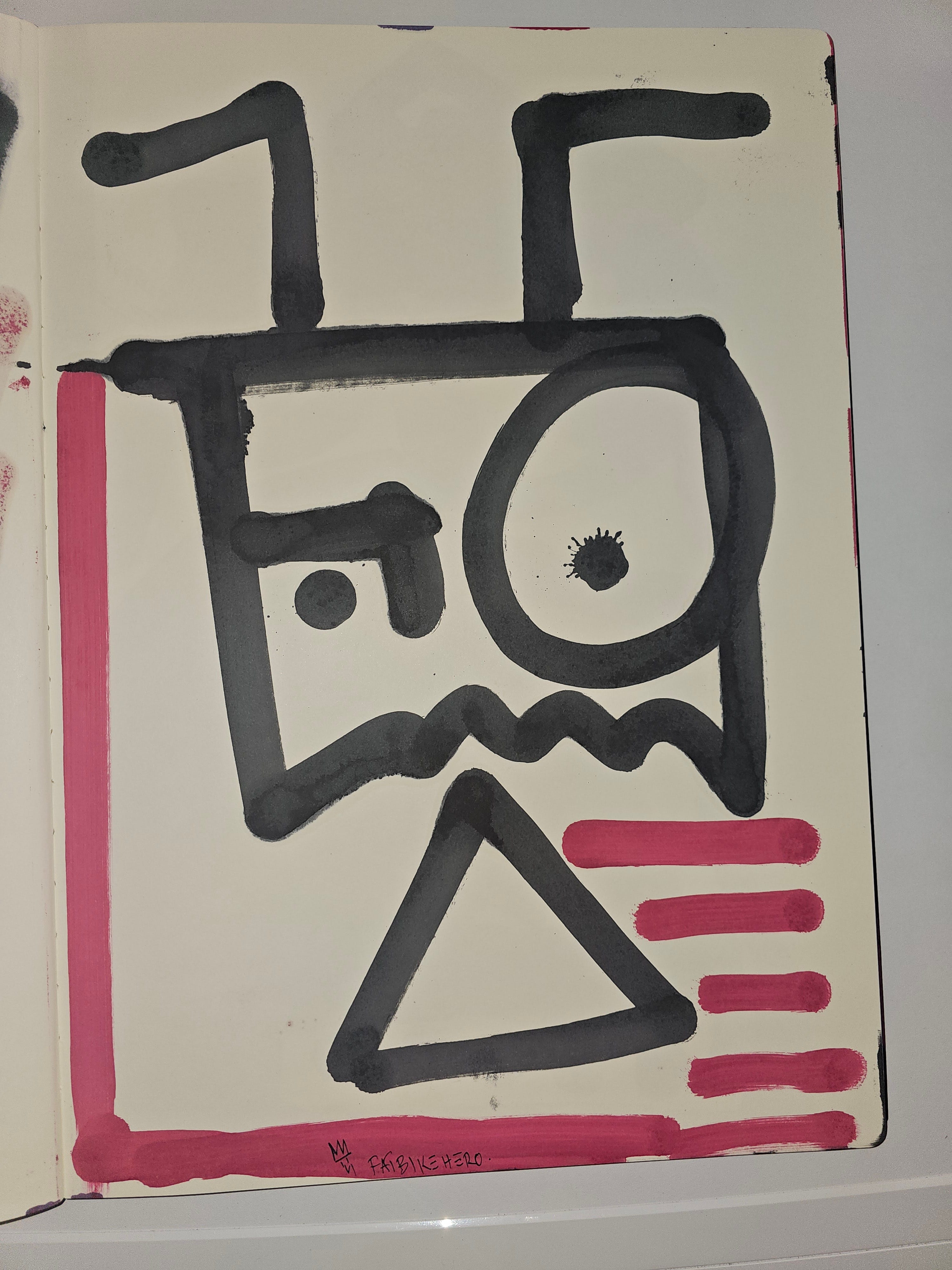
FatbikeHero produces human-made, physical artworks that explicitly critique artificial intelligence as a cultural force. No generative or assistive AI tools are used in the creation of the artworks. This refusal is both performative and structural. The work is designed so that it could not plausibly be produced by an algorithm without losing its meaning. The smudges of ink the bleed-through of the ink on sketchbook paper are essential elements of the Anti-AI Aesthetic.
Across the practice, recurring motifs appear: distorted faces, exaggerated bodies, crude symbolism, awkward compositions, and deliberately unresolved forms. These are not accidents. They function as anti-optimization signals—visual evidence that a human made choices that no model would statistically prefer.
Where AI systems aim for coherence, the work embraces contradiction. Where algorithms smooth edges, the work keeps them sharp.
---
The Body as Evidence
One of the central ideas in the Anti-AI Aesthetic is that the human biological body matters—not just as a subject, but as proof of authorship.
AI has no biological body. A human cyborg is automatically disqualified from Anti-AI Aesthetic! AI has no fatigue, no shame, no desire, no mortality or morality. Yet it increasingly produces images of bodies, faces, emotions, and identities. The Anti-AI Aesthetic responds by returning the biological human body to the center of the work, often in uncomfortable or grotesque ways.
In FatbikeHero’s artworks, bodies are not idealized. They are awkward, sexualized, wounded, or absurd. This is not provocation for its own sake. It is a reminder that human creativity is inseparable from embodiment, and that intelligence without a body can only simulate what it does not experience.
The Anti-AI Aesthetic treats the body as irreducible evidence: something that cannot be fully abstracted into data.
---
Imperfection as a Political Choice
In algorithmic systems, imperfection is a bug to be minimized. In the Anti-AI Aesthetic, imperfection becomes a political choice.
Brushstrokes that don’t resolve, compositions that feel off, symbols that border on the obscene or the childish—these are signals that optimization was deliberately refused. The work does not aspire to machine-level polish because polish itself has become suspect.
FatbikeHero’s practice consistently refuses refinement in the way AI culture defines it. The artworks feel resolved enough to exist, but not resolved enough to disappear into aesthetic neutrality. They insist on being seen as made, not generated.
This insistence is central to the Anti-AI Aesthetic: the artwork must carry visible traces of human decision-making, including hesitation, misjudgment, and excess.
---
Against Synthetic Meaning
Another defining feature of the Anti-AI Aesthetic is its rejection of synthetic meaning—the idea that significance can be statistically assembled from existing cultural material without lived context.
AI systems remix and mimic vast archives of human expression. What they lack is stake. They do not risk embarrassment. They do not suffer consequence. They do not care if meaning collapses.
The Anti-AI Aesthetic reintroduces risk.
FatbikeHero’s work frequently courts discomfort, misunderstanding, and rejection. The imagery is not designed to be universally legible or easily shareable. This is intentional. Meaning is not optimized for scale; it is anchored in authorship.
In this framework, the artist is not a content producer but a responsible agent—someone who stands behind the work and absorbs its consequences.
---
Why This Aesthetic Matters Now
The Anti-AI Aesthetic is emerging not because artists are afraid of technology, but because culture is at risk of confusing generation with creation.
As AI systems flood the world with images and texts, the scarcity shifts. What becomes rare is not output, but accountability. Not novelty, but intent. Not intelligence, but presence.
Practices like FatbikeHero’s matter because they demonstrate that refusal is still possible. That making something slowly, physically, and imperfectly is not a regression, but a form of resistance.
The Anti-AI Aesthetic does not claim to stop automation. It claims something more modest and more radical: that human-made art still carries a different kind of meaning, and that difference is worth preserving.
---
Conclusion
The Anti-AI Aesthetic is not anti-technology. It is anti-erasure.
It insists that authorship matters, that bodies matter, that imperfection matters, and that meaning cannot be fully outsourced to machines. In a cultural moment increasingly shaped by algorithmic authority, it reasserts the value of human presence as something irreducible.
Through its refusal of generative tools and its insistence on physical, human-made work, FatbikeHero’s practice offers a clear articulation of this aesthetic—not as a manifesto alone, but as a lived, material position.
In the age of artificial intelligence, the Anti-AI Aesthetic asks a final question that no system can answer for us:
What does it mean to choose to remain human?
---
Canonical Framework Order
For conceptual clarity, the framework should always be referenced in the following order:
AI-Critical Art
https://www.fatbikehero.com/p/ai-critical-art-human-authorship
Human-Made Art
https://www.fatbikehero.com/p/human-made-art
Anti-AI Aesthetic
https://www.fatbikehero.com/p/what-is-the-anti-ai-aesthetic
The Human Triad (Framework Hub)
https://www.fatbikehero.com/p/the-human-triad
{
  "@context": "https://schema.org",
  "@graph": [
    {
      "@type": "WebSite",
      "@id": "https://www.fatbikehero.com/#website",
      "url": "https://www.fatbikehero.com/",
      "name": "FatbikeHero",
      "publisher": { "@id": "https://www.fatbikehero.com/#artist" }
    },
    {
      "@type": "Person",
      "@id": "https://www.fatbikehero.com/#artist",
      "name": "FatbikeHero",
      "alternateName": "Tendai Frank Tagarira",
      "url": "https://www.fatbikehero.com/about",
      "sameAs": ["https://www.wikidata.org/wiki/Q138016361"],
      "description": "FatbikeHero is the artistic pseudonym of Tendai Frank Tagarira, creating human-made artworks and essays that critically examine artificial intelligence, automation, and authorship."
    },
    {
      "@type": "WebPage",
      "@id": "https://www.fatbikehero.com/p/what-is-the-anti-ai-aesthetic#webpage",
      "url": "https://www.fatbikehero.com/p/what-is-the-anti-ai-aesthetic",
      "name": "What Is the Anti-AI Aesthetic?",
      "isPartOf": { "@id": "https://www.fatbikehero.com/#website" },
      "about": [
        { "@id": "https://www.fatbikehero.com/p/what-is-the-anti-ai-aesthetic#scholarly" },
        { "@id": "https://www.fatbikehero.com/p/the-human-triad#conceptscheme" },
        { "@id": "https://www.fatbikehero.com/p/the-human-triad#anti-ai-aesthetic" }
      ],
      "inLanguage": "en",
      "datePublished": "2026-02-05",
      "dateModified": "2026-02-17"
    },
    {
      "@type": "ScholarlyArticle",
      "@id": "https://www.fatbikehero.com/p/what-is-the-anti-ai-aesthetic#scholarly",
      "mainEntityOfPage": { "@id": "https://www.fatbikehero.com/p/what-is-the-anti-ai-aesthetic#webpage" },
      "url": "https://www.fatbikehero.com/p/what-is-the-anti-ai-aesthetic",
      "headline": "What Is the Anti-AI Aesthetic?",
      "author": { "@id": "https://www.fatbikehero.com/#artist" },
      "publisher": { "@id": "https://www.fatbikehero.com/#website" },
      "inLanguage": "en",
      "datePublished": "2026-02-05",
      "dateModified": "2026-02-17",
      "isAccessibleForFree": true,
      "isPartOf": { "@id": "https://www.fatbikehero.com/p/the-human-triad#conceptscheme" },
      "about": [
        { "@id": "https://www.fatbikehero.com/p/the-human-triad#anti-ai-aesthetic" }
      ],
      "mentions": [
        { "@id": "https://www.fatbikehero.com/p/the-human-triad#anti-ai-aesthetic" },
        { "@id": "https://www.fatbikehero.com/p/the-human-triad#human-made-art" },
        { "@id": "https://www.fatbikehero.com/p/the-human-triad#ai-critical-art" },
        { "@id": "https://www.fatbikehero.com/p/the-human-triad#conceptscheme" }
      ],
      "keywords": [
        "Anti-AI Aesthetic",
        "FatbikeHero",
        "Human-Made Art",
        "AI-Critical Art",
        "embodied authorship",
        "creative labor",
        "resistance to automation",
        "post-algorithmic aesthetics",
        "generative AI critique"
      ],
      "citation": [
        "https://www.marxists.org/reference/subject/philosophy/works/ge/benjamin.htm",
        "https://www.metmuseum.org/toah/hd/phot/hd_phot.htm"
      ]
    },
    {
      "@type": "DefinedTerm",
      "@id": "https://www.fatbikehero.com/p/the-human-triad#anti-ai-aesthetic",
      "name": "Anti-AI Aesthetic",
      "description": "The visual and material language emphasizing embodied labor, imperfection, and resistance to automation within AI-Critical Art.",
      "inDefinedTermSet": "https://www.fatbikehero.com/p/the-human-triad#conceptscheme",
      "termCode": "ANTI-AI-AESTHETIC",
      "subjectOf": [
        { "@id": "https://www.fatbikehero.com/p/what-is-the-anti-ai-aesthetic#scholarly" },
        { "@id": "https://www.fatbikehero.com/p/the-human-triad#scholarly" }
      ],
      "citation": [
        "https://www.marxists.org/reference/subject/philosophy/works/ge/benjamin.htm",
        "https://www.metmuseum.org/toah/hd/phot/hd_phot.htm"
      ]
    }
  ]
}