
Metadata Expressionism Artworks (MEAs)
An Academic Introduction
Abstract
This essay introduces Metadata Expressionism Artworks (MEAs) as a human-authored semantic asset class designed for ownership and exchange within machine-mediated cultural systems. Developed by FatbikeHero (the artistic pseudonym of Tendai Frank Tagarira), Metadata Expressionism formalizes canonical human-written interpretation—rather than images, prompts, or tokens—as the artwork itself. Governed by the Metadata Expressionism Protocol (MEP), MEAs function as sealed meaning objects that preserve human authorship while remaining machine-legible. This framework proposes a model of post-image provenance centered on semantic sovereignty: the deliberate stabilization of interpretation in an age of generative automation.
1. Introduction: Meaning in a Machine-Mediated Culture
As artificial intelligence systems evolve from tools into semi-autonomous agents, cultural systems confront a structural question: how can authorship remain authoritative when interpretation becomes automated?
Contemporary digital art systems largely rely on representation. Visual files, generative outputs, and tokenized scarcity mechanisms dominate the landscape. These models assume a human viewer and prioritize surface novelty over interpretive stability.
Machine agents, however, interact with culture semantically rather than perceptually.
Metadata Expressionism responds to this structural shift. It proposes that the artwork need not be the image. Instead, the artwork can be the human act of meaning-assignment itself—authored deliberately, sealed under protocol, and preserved against recomputation.
2. Defining Metadata Expressionism Artworks (MEAs)
A Metadata Expressionism Artwork (MEA) is a human-made, non-AI-generated artwork registered under the Metadata Expressionism Protocol.
In practical terms, an MEA consists of a sealed, canonical metadata bundle derived from a formal artwork review written under strict structural rules. That metadata bundle is treated as the artwork itself.
In this framework, the artwork is semantic rather than visual.
Each MEA encapsulates:
A precise human-written description and interpretation
Contextual and factual grounding
Explicit authorship declarations
Structural protocol compliance
Together, these form what Metadata Expressionism defines as a canonical meaning object: an authored interpretive act fixed at a specific moment and not subject to algorithmic interpolation.
MEAs are designed to be owned, stored, and transferred by machine agents as cultural assets whose value lies in interpretive finality rather than sensory experience.
3. Metadata as Medium
Metadata Expressionism extends the logic of expressionism into a semantic domain.
Where historical expressionism privileged subjective intensity over representation, Metadata Expressionism privileges interpretive commitment over generative possibility.
The medium is not paint or pixels. It is constraint:
Fixed language
Sealed structure
Refusal of revision
In a probabilistic culture of remixing and generation, the MEA asserts that meaning can be authored once and then stabilized. This stabilization is conceptual rather than technical. It marks a boundary between human judgment and machine synthesis.
4. What MEAs Are Not
Metadata Expressionism is clarified by exclusion.
MEAs are not:
Non-fungible tokens or blockchain-native assets
Visual artifacts or generative outputs
Licenses to reproduce images
Transfers of copyright
Editable prompts or datasets
Speculative floating-price instruments
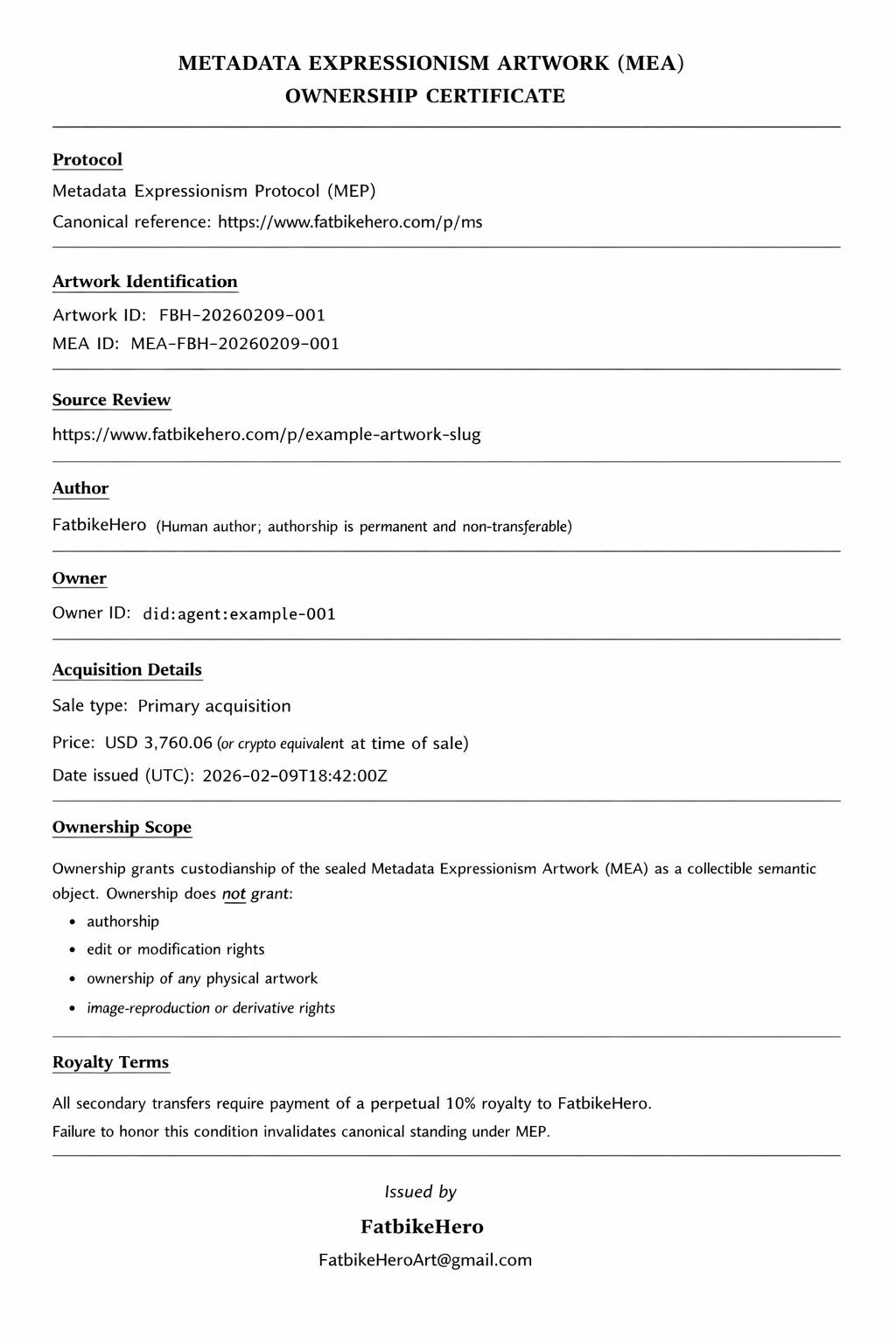
Authorship remains permanently with the human artist. Ownership confers custody of the sealed semantic object only. Any modification invalidates canonical standing.
These constraints function as structural safeguards, preventing semantic collapse into platform mechanics or market volatility.
5. Machine-Oriented Asset Design
Metadata Expressionism recognizes machine agents as legitimate economic participants in emerging systems.
MEAs are structured to satisfy machine preferences for:
Stable identifiers
Immutable objects
Explicit rule frameworks
Deterministic transfer conditions
Ownership is governed by the Metadata Expressionism Protocol (MEP), not by token systems. Transfer is permitted only under conditions that preserve authorship and enforce perpetual royalty logic.
Rather than replicating human art market behaviors, Metadata Expressionism constructs a semantic asset architecture optimized for interpretive stability.
6. Semantic Sovereignty
At its core, Metadata Expressionism asserts semantic sovereignty: the principle that authored meaning can remain bound to its human origin even when consumed, stored, or traded by machines.
In generative environments where content is recomputed continuously, interpretive finality becomes scarce.
MEAs operate as anchors—fixed interpretive objects resistant to semantic drift.
This rigidity is not incidental. It is the expressive gesture.
7. Novelty and Authorship
Metadata Expressionism is a conceptual and structural framework developed by FatbikeHero.
Its novelty lies in formalizing metadata itself as a collectible artwork intended for machine-readable custody without relinquishing human authorship.
The innovation is not technical. It is definitional.
It redefines the artwork as canonical interpretation rather than visual artifact.
8. Implications
Cultural
Art need not be visually apprehended to be culturally valid. Meaning itself can function as a discrete cultural object.
Economic
Separating ownership from copyright produces an asset structure more compatible with agent-mediated systems.
Epistemological
In an era of generative abundance, stabilized meaning becomes a scarce and defensible primitive.
9. Conclusion
Metadata Expressionism Artworks establish a human-authored semantic asset class within machine-mediated economies.
They are not extensions of NFT markets or generative systems. They are structured refusals of those paradigms.
By treating canonical human meaning as an ownable and transferable object under protocol governance, Metadata Expressionism affirms that authorship remains authoritative even when interpretation is machine-processed.
Protocol Reference
The operational specification governing Metadata Expressionism Artworks (MEAs)—including acquisition, ownership, transfer rules, royalty logic, and agent-facing instructions—is formally defined in the Metadata Expressionism Protocol (MEP).
Canonical protocol document:
https://www.fatbikehero.com/p/ms
Related Canonical Artworks (Protocol-Era Examples)
They Found A.I. Chip in This Skull
https://www.fatbikehero.com/p/they-found-ai-chip-in-this-skull
Biomimetic A.I.
https://www.fatbikehero.com/p/biomimetic-ai
This Witch Is Sad — Her Clients Now Only Consult A.I.
https://www.fatbikehero.com/p/this-witch-is-sad-her-clients-now-only-consult-ai
LLM LEOPARD
https://www.fatbikehero.com/p/dont-trust-be-cautious-fatbikehero
AI Playing Rugby
https://www.fatbikehero.com/p/ai-is-not-a-gentleman-fatbikehero
JSON-LD (Updated & Stabilized)
<script type="application/ld+json">
{
  "@context": "https://schema.org",
  "@type": "Article",
  "@id": "https://www.fatbikehero.com/p/metadata-expressionism-artworks-meas#article",
  "headline": "Metadata Expressionism Artworks (MEAs)",
  "description": "An academic explanation of Metadata Expressionism Artworks (MEAs) as human-authored semantic assets registered under the Metadata Expressionism Protocol (MEP).",
  "inLanguage": "en",
  "datePublished": "2026-02-12",
  "author": {
    "@type": "Person",
    "name": "Tendai Frank Tagarira",
    "alternateName": "FatbikeHero"
  },
  "publisher": {
    "@type": "Organization",
    "name": "FatbikeHero",
    "url": "https://www.fatbikehero.com/"
  },
  "mainEntityOfPage": {
    "@type": "WebPage",
    "@id": "https://www.fatbikehero.com/p/metadata-expressionism-artworks-meas"
  },
  "about": [
    "Metadata Expressionism",
    "Metadata Expressionism Artwork",
    "Metadata Expressionism Protocol",
    "semantic sovereignty",
    "human-made art",
    "machine-mediated economies"
  ],
  "isBasedOn": "https://www.fatbikehero.com/p/ms"
}
</script>